Montessori Number Rods for Math at Home
In many Indian homes, particularly with our bustling joint families and sometimes cosy apartments, finding engaging ways to introduce complex subjects like mathematics to young children can feel like a delightful challenge. Yet, imagine a method that makes numbers tangible, joyful, and utterly intuitive for your little one. This is precisely what the Montessori approach offers, and today, we're diving into one of its most beloved materials: the Montessori Number Rods.
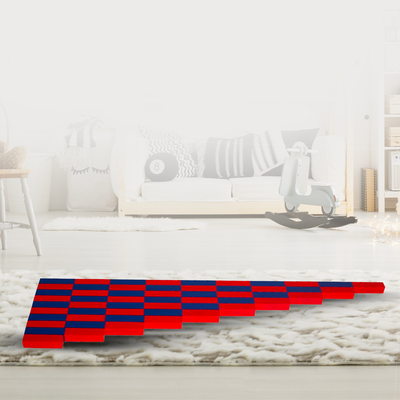
Montessori Number Rods are a set of ten wooden rods, varying in length from 10 cm to 100 cm, painted alternately red and blue in segments of 10 cm. Each rod represents a quantity from one to ten, with the shortest rod being one unit and the longest being ten units. This ingenious material works because it allows children to visually and physically grasp the concept of quantity and sequence before abstract symbols are introduced. Parents can use these rods to build a strong foundation in number sense, counting, and even early addition and subtraction. You can explore a wide range of similar hands-on learning tools in our Montessori mathematics materials collection.
Understanding the Montessori Approach to Math
Maria Montessori, the pioneer behind this revolutionary educational philosophy, believed that children learn best by doing. Her method transitions learning from the concrete to the abstract, always respecting the child's natural pace and curiosity. For mathematics, this means providing tangible materials that children can manipulate, feel, and explore with their senses. This hands-on experience builds a deep, intuitive understanding of numerical concepts, far beyond rote memorisation.
In the Montessori classroom, and ideally in a Montessori at home India setup, children are not just taught numbers; they experience them. They see that '3' is not just a symbol, but a specific length, a particular weight, and a quantity that feels different from '2' or '4'. This sensorial foundation is crucial for developing strong cognitive skills and a lifelong love for learning, especially in early child development India.
Introducing the Number Rods to Your Child
Typically, the Number Rods are introduced to children between 2.5 and 3.5 years old, once they have developed some fine motor skills and a basic ability to follow instructions. Find a quiet corner in your home, perhaps with a small mat, to create a focused workspace. Invite your child to join you and gently introduce the rods, laying them out in a mixed-up order.
Begin by showing them how to arrange the rods from shortest to longest, or vice versa. This simple activity already develops their visual discrimination and understanding of seriation. There's no pressure to count at this stage; the focus is on experiencing the difference in length. Remember, the Montessori way is about observation and discovery, allowing your child to lead their learning journey.
Engaging Activities with Montessori Number Rods
Once your child is comfortable arranging the rods, you can move on to more structured activities. These exercises are not just about counting; they are about understanding what each number truly represents.
Learning Numbers 1 to 10
This is where the magic of the red and blue segments comes in. Lay out the rods in order. Point to the shortest rod and say, "This is one." Have your child trace their finger along its length. Then move to the next rod, saying "This is two," tracing both segments. Continue this until ten, emphasising the one-to-one correspondence between the segments and the number name. Repeat this exercise, allowing your child to touch, feel, and connect the quantity with its name.
You can make this even more engaging by connecting it to everyday Indian life. "Can you show me the 'two' rod, just like we have two hands to clap for Diwali?" or "This is the 'five' rod, like the five fingers on your hand!" This helps integrate Montessori learning activities naturally into their world. For more materials that aid in this holistic development, explore our main Montessori method learning materials and toys.
Exploring Addition and Subtraction
Once your child has a firm grasp of numbers 1-10 with the rods, you can gently introduce basic operations. To demonstrate addition, take the '3' rod and the '2' rod. Place them end-to-end. Then, ask your child to find the single rod that matches the combined length. They will discover it's the '5' rod. This visual, concrete representation makes the concept of '3 plus 2 equals 5' immediately understandable.
Similarly, for subtraction, you can start with a longer rod, say the '7' rod. Ask your child to remove a section (e.g., place the '3' rod on top of the '7' rod, aligning one end). The remaining length will correspond to the '4' rod. These hands-on explorations, often with high-quality wooden toys like the rods, are invaluable for teaching maths at home and building early problem-solving skills without relying on abstract symbols too soon.
Remember, the goal isn't speed but understanding. Allow your child to experiment, make mistakes, and discover relationships at their own pace. This approach makes maths an adventure, not a chore, for children, laying a strong foundation for future learning.
Key Takeaways
- Montessori Number Rods are a concrete, sensorial material for teaching foundational math concepts.
- They help children visually and physically understand quantities from one to ten.
- Introduce the rods around 2.5-3.5 years, focusing on seriation before counting.
- Activities progress from arranging to naming quantities, then to basic addition and subtraction.
- Connect learning to the child's environment and Indian cultural context for deeper engagement.
- The Montessori approach prioritises understanding through experience over rote memorisation.
Frequently Asked Questions
At what age should I introduce Montessori Number Rods?
Montessori Number Rods are typically introduced to children between 2.5 and 3.5 years old. The key is observing if your child shows an interest in length, order, and can follow simple instructions for laying them out.
How do I know if my child is ready for Number Rods?
Your child is likely ready if they can focus for short periods, enjoy hands-on activities, and show a curiosity about different sizes or sequences. There's no rush; readiness is more about developmental stage than chronological age.
Can I make my own Number Rods at home?
While you can attempt DIY versions, authentic Montessori Number Rods are precisely crafted to exact measurements and colours, which is crucial for the material's self-correcting and sensorial qualities. Investing in quality educational toys ensures the full learning benefit.
What if my child isn't interested in the Number Rods?
If your child isn't interested, put the rods away for a few weeks and reintroduce them later. Never force the activity. Children have sensitive periods for learning, and their interest may peak at a different time. Keep it fun and inviting!
Teaching maths at home with Montessori Number Rods can be a truly enriching experience for both you and your child. By providing these wonderful, tangible tools, you're not just teaching numbers; you're nurturing a curious, confident, and capable young mind. Find these and many more thoughtfully designed educational toys for your home at SkilloToys.com.