Building Strong Number Sense: Why Place Value is Key for Young Learners
As parents, we all want to give our children the best start, especially when it comes to fundamental skills like mathematics. But how do you make abstract concepts like numbers and place value engaging for a 4 or 5-year-old? The key often lies in hands-on, tangible learning experiences.
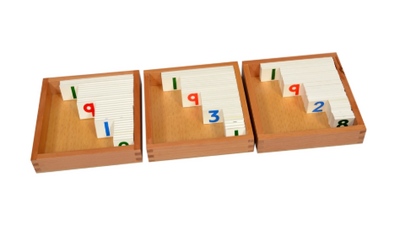
Enter the world of Montessori education, where learning is an adventure of discovery. The Small Number Cards 1 to 3000 are a prime example of an educational wooden toy designed to demystify numbers from units to thousands. This carefully crafted set helps young learners, typically aged 4 to 5 years, build a concrete understanding of how numbers are formed and what each digit truly represents.
How Do These Cards Boost Early Math Skills?
This Montessori learning toy isn't just about counting; it's about deep understanding. Here’s how these small number cards become a powerhouse for early development skills and lay a solid foundation for future math success.
Mastering Place Value Awareness
One of the biggest hurdles in early math is grasping place value – understanding that the '1' in '10' is different from the '1' in '100'. With separate cards for units (green), tens (blue), hundreds (red), and thousands (green), children visually and tactually separate and combine numbers. This system helps them clearly see the composition of larger numbers, making concepts like 235 not just a sequence of digits, but two hundreds, three tens, and five units.
Building a Foundation for Arithmetic Operations
Beyond just recognizing numbers, these cards lay the groundwork for addition, subtraction, multiplication, and division. By manipulating the cards, children can physically 'build' numbers like 1,234 and then perform simple operations. This hands-on approach makes abstract arithmetic concepts concrete and understandable, boosting early math fluency.
Connecting Quantity to Numeral
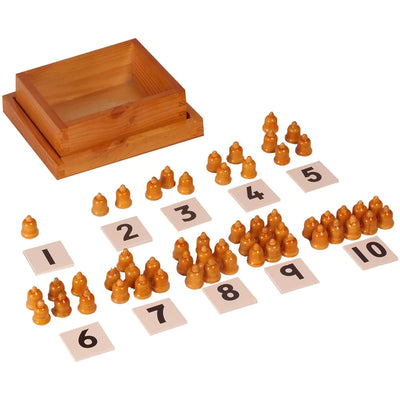
For children aged 4-5, it’s crucial to link the abstract symbol (the numeral) to a concrete quantity. When used alongside decimal bead materials, these cards help bridge that gap effectively. They allow children to see, touch, and count quantities, then match them with the corresponding number card, reinforcing the meaning behind each digit and developing strong quantitative reasoning.
Montessori Magic: Designed for Little Hands & Minds
The thoughtful design of these cards is rooted in Montessori principles, which advocate for self-directed, hands-on learning. The cards are proportionally sized, made from thick, durable material, and housed in beautiful beech wood boxes with finger-jointed edges. The use of specific Montessori-standard color codes (green for units and thousands, blue for tens, red for hundreds) provides consistent visual cues that aid memory and learning, making this a truly effective educational wooden toy.
Bringing Math Home: Fun Activities for Parents
How can Indian parents best utilize these number cards at home? There are many engaging ways to integrate them into daily play. You can start by simply laying out the unit cards and asking your child to identify them. As they progress, introduce the tens, hundreds, and thousands, showing them how to build numbers like 45, 123, or 2,567 by overlaying the cards.
Make it a game – for instance, "Can you show me the number one hundred and five?" or "Let's count how many apples we have and find the right card!" This active participation encourages problem-solving skills and makes learning math fun and interactive for your little one.
Invest in your child's mathematical journey with our Montessori math materials. SkilloToys is dedicated to providing high-quality educational toys that inspire curiosity and foster a love for learning. Explore our diverse collection of flashcards and more at SkilloToys.com to discover innovative ways to support your child's growth.