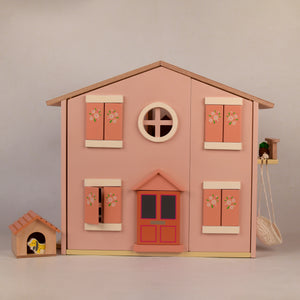
Doll House for Kids: Nurturing Healthy Habits in Indian Homes
A simple doll house for kids offers a powerful, often overlooked, way to instill vital healthy habits right in your Indian home. Child development experts agree that imaginative play, especially with realistic props like a dollhouse, provides a safe and engaging platform for children to internalize complex routines and behaviors related to nutrition, sleep, and active living. This hands-on, self-directed learning aligns perfectly with Montessori principles, preparing children not just for school, but for a lifetime of well-being.
What exactly is a dollhouse in the context of healthy habits? A dollhouse is a miniature, often realistic, representation of a home environment that children use for imaginative play. This matters because it serves as a 'rehearsal space' for real-life scenarios, allowing children to practice and internalize daily routines without real-world consequences. Indian parents can leverage this by intentionally setting up scenarios that reinforce positive eating, sleeping, and active lifestyle choices for their children.
Montessori Dollhouse & Healthy Eating: A Playful Approach to Nutrition
Research consistently shows that engaging children in food-related activities significantly boosts their willingness to try new foods and understand balanced nutrition. A Montessori dollhouse provides an ideal setting for this. Imagine little Aarav in Bengaluru meticulously arranging tiny vegetables in his dollhouse kitchen, preparing a 'healthy lunch' for his dolls before they 'go to school'. He's learning about different food groups and the concept of a meal, all through imaginative play.
This kind of imaginative play nutrition is far more impactful than direct instruction alone. When children role-play healthy eating scenarios – perhaps the dolls are celebrating a festival with traditional healthy snacks like fruit chaat or homemade ladoos instead of just sugary treats – they're not just playing; they're internalizing. They mimic their parents, grandparents, and even their favourite cartoon characters, bringing those observations into their dollhouse world. This helps cement the idea that healthy choices are normal and enjoyable.
You can encourage this further by providing small, realistic play food items that represent common Indian vegetables, fruits, and simple meals. Ask your child questions like, "What are your dolls having for breakfast today? Is it strong enough for a busy day of play?" This dialogue reinforces the connection between food and energy, a practical lesson that extends beyond the dollhouse walls. Explore activity kits that encourage culinary exploration.
Role-Play & Children's Sleep Routines: Sweet Dreams for Dolls, Better Sleep for Kids
Establishing consistent children's sleep routines can be a challenge in many Indian households, especially with varying family schedules, late-night events, or the common practice of co-sleeping. A dollhouse offers a unique, low-pressure way to address this. Consider little Meera in Delhi, whose dolls dutifully follow a bedtime routine: a warm 'bath', changing into nightclothes, a quiet 'story time', and then being tucked into their tiny beds.
This role play healthy eating and sleep sequence is a powerful learning tool. Maria Montessori emphasized the importance of order and routine for a child's developing mind. By repeatedly acting out these sleep rituals with their dolls, children build a strong cognitive framework for what 'bedtime' entails. They learn self-regulation, understanding the cues and steps involved in winding down.
You might observe your child telling a doll, "No more TV now, it's time to sleep!" or "Don't forget to brush your teeth before bed." These are direct reflections of lessons they are absorbing. Encouraging quiet play and gentle routines in the dollhouse before their own bedtime can create a seamless transition, making their own sleep routine feel less like a chore and more like a natural progression of their day, just like their dolls.
Dollhouse Benefits for Kids: Fostering Active Play and Movement
In our increasingly urbanized Indian cities, outdoor active play often takes a backseat to screens or academic pressures. However, a dollhouse can subtly promote the importance of movement. While a dollhouse itself isn't a jungle gym, it's a launchpad for narratives that include active play. Imagine the dolls in the dollhouse 'going to the park' to play, 'climbing' a tree, or 'exercising' in their garden. This imaginative extension encourages children to value physical activity.
A child might have their dolls 'run races' or 'dance' at a family celebration, integrating movement into their play narrative. This helps children develop an understanding of a holistic lifestyle where physical activity is just as important as eating and sleeping well. The dollhouse acts as a stage where children can create stories that mirror and shape their understanding of the world.
By talking about the dolls' 'adventures' or suggesting, "Maybe the dolls should go for a walk to the market," you can guide their play towards incorporating physical movement. This indirect encouragement is often more effective than direct commands, aligning with the Montessori principle of following the child's lead while gently guiding their development. Discover more Montessori toys that inspire comprehensive development.
Integrating Healthy Habits into Indian Family Life with a Dollhouse
The beauty of a doll house for kids in an Indian context is its adaptability. In a joint family setting, children can replicate the roles of different family members – Dadi cooking healthy meals, Mama reading a bedtime story, or Papa encouraging outdoor games. This not only reinforces healthy habits but also strengthens their understanding of family roles and cultural practices.
Child development experts emphasize that children learn by doing and by observing. A dollhouse provides a tangible space for both. It's a miniature world where the lessons of cleanliness, healthy food choices, consistent routines, and physical activity are practiced, processed, and ultimately, internalized. It helps bridge the gap between abstract concepts and concrete understanding, preparing them for the demands of school and a balanced life.
The next time you see your child engrossed in their dollhouse, remember they are not just playing. They are building a foundation for their future well-being, one imaginative meal, one gentle bedtime story, and one playful adventure at a time. It's an investment in their holistic development, empowering them to make healthy choices independently as they grow.