Montessori Math Sequence: Concrete to Abstract at Home
In many Indian homes, creating a focused learning environment can be a beautiful challenge. If you're exploring homeschooling or enriching early years, understanding the Montessori math sequence is key. It guides children from tangible experiences to abstract numbers, respecting their natural curiosity.
The Montessori math approach teaches children by doing. It's a sequential method using concrete, hands-on materials. This works because young children are sensory learners, absorbing information through touch and sight. Parents can foster deep, intuitive math understanding at home.
Building Foundations with Concrete Materials
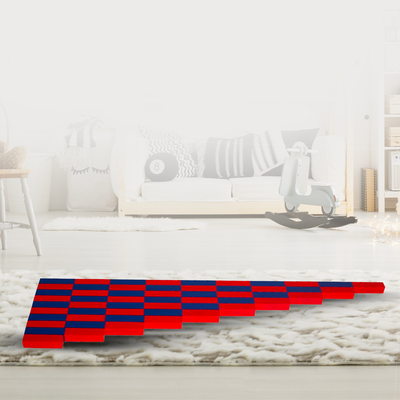
Maria Montessori noted children need to touch and experience quantity before calculating. Early Montessori math uses sensorial materials. Imagine a child's excitement arranging Red Rods, understanding length, or counting Number Rods. Each rod physically represents a quantity.
Many foundational tools, from Red Rods to Number Rods, are available as high-quality wooden toys, fitting perfectly into small home learning spaces.
Quantity and Symbol: Numbers 1-10
Once quantity is experienced, symbols are introduced with tactile Sandpaper Numerals. Your child traces '1' while counting one bead, linking feel, sound, and sight. This multisensory approach solidifies understanding.
In an Indian home, integrate this daily. Count 'three' laddus for Ganesh Chaturthi, making math part of life.
The Decimal System: Golden Beads
The Montessori decimal system is brilliant. Children work with Golden Bead Material – units, tens, hundreds, and thousands, physically combining them to understand place value. This is the bedrock for future arithmetic.
Find excellent Montessori mathematics materials, including Golden Beads, to help children grasp complex concepts with ease.
Bridging to Abstraction: Operations
After extensive concrete work, children internalize concepts. They move from physically adding Golden Beads to understanding addition itself. The Montessori math sequence patiently guides this transition.
Stamp Game and Small Bead Frame
The Stamp Game bridges Golden Beads to abstract calculation. 'Stamps' represent units, tens, hundreds, and thousands. Children perform all four operations, solidifying understanding. The Small Bead Frame then introduces larger numbers and complex mental calculations.
For parents keen on Montessori at home India, the goal is comprehension. Incorporate everyday counting during grocery runs or meal prep, reinforcing Montessori learning activities.
To support holistic development, explore the full range of Montessori method learning materials and toys designed for comprehensive child development in India.
Independent Learning & Child Development
Montessori emphasizes self-correction and independent learning. Materials let children identify errors, fostering problem-solving and self-reliance. This approach is perfect for child development India.
Whether in a joint family or nuclear home, a dedicated 'work area' for these materials signals respect for your child's learning. These educational toys for toddlers foster profound cognitive growth.
Key Takeaways
- The Montessori math sequence progresses from concrete, hands-on experiences to abstract understanding.
- Children aged 0-6 learn best through sensory exploration and material manipulation.
- Early stages establish quantity and associate it with symbols (e.g., Number Rods, Sandpaper Numerals).
- The Golden Bead Material introduces the decimal system and place value physically.
- Tools like the Stamp Game and Small Bead Frame bridge to abstract arithmetic operations.
- Montessori fosters independent learning, self-correction, and deep conceptual understanding of math.
- Integrating Montessori math at home involves suitable materials and daily life application.
Frequently Asked Questions (FAQ)
What is the Montessori approach to math?
The Montessori approach to math introduces concepts using concrete, tactile materials children manipulate. It moves sequentially from tangible experiences of quantity to abstract symbols, fostering a deep, intuitive grasp of mathematical principles.
At what age can my child start Montessori math?
Children can begin with foundational Montessori math concepts, like one-to-one correspondence, as early as 2.5-3 years. The progression is individual, allowing each child to move at their own pace through the sequence of materials.
How can I introduce Montessori math at home without all the materials?
While specific materials are ideal, incorporate counting into daily routines (e.g., spoons, fruits). Use household items for quantities, discuss shapes, and make comparisons (more/less). SkilloToys.com offers many materials that can be slowly introduced.
Why is the concrete to abstract progression important in Montessori math?
This progression is crucial because young children's brains are wired for concrete learning. They need to physically experience concepts to build a strong mental framework, preventing rote memorization without true understanding.
Embracing the Montessori math sequence at home isn't just about teaching numbers; it's about nurturing a love for learning and discovery. At SkilloToys.com, we provide high-quality, authentic Montessori materials to support this incredible journey for your little ones, right here in India.