Making Math Fun: Introducing Fractions Early with Play
As parents, we constantly seek ways to give our children the best start, and often that includes building a strong foundation in academics, even from a young age. Math, in particular, can seem daunting, but what if learning fractions could be as simple and fun as playing with a puzzle?
Early exposure to foundational math concepts, presented in an engaging way, can truly make a world of difference. It’s not about rote memorization, but about sparking curiosity and understanding. This is precisely where the Wooden Fraction Puzzle Board shines, transforming abstract ideas into tangible, playful lessons.
Why Early Fraction Learning is So Important for Young Minds
Introducing fractions early isn't about rushing your child into advanced math. Instead, it's about building a solid cognitive framework. Understanding 'parts of a whole' helps children develop logical thinking and problem-solving skills long before they encounter complex equations.
This early exposure is a key component of 'early development skills,' preparing their brains for future learning. It allows them to visualize and grasp concepts intuitively, making the transition to more formal math education much smoother and less intimidating.
What Skills Will Your Child Develop with This Educational Wooden Toy?
The Wooden Fraction Puzzle Board is more than just a toy; it's a comprehensive learning tool designed to foster multiple developmental areas. Parents looking for 'best toys for toddlers' or 'Montessori learning toys' will find this puzzle particularly beneficial.
Fine Motor Skills and Hand-Eye Coordination
Each puzzle piece is thoughtfully raised above the tray, making it easy for little fingers to grasp and manipulate. This simple feature significantly enhances fine motor skills and hand-eye coordination as children practice placing and removing the pieces.
Cognitive Development and Logical Thinking
As children fit the self-correcting pieces, they naturally engage in logical thinking and problem-solving. They learn about relationships between different parts and how they form a whole, laying the groundwork for basic math concepts like addition and subtraction.
Introduction to Early Math Concepts
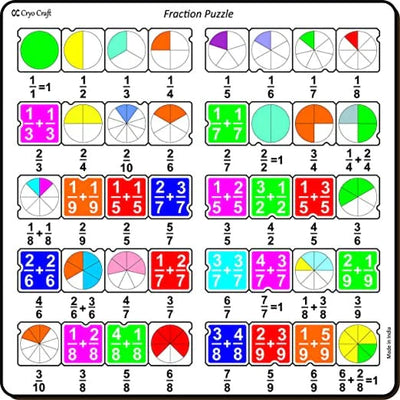
Visually representing fractions like halves, thirds, and quarters makes these abstract ideas concrete and understandable. Your child learns through direct interaction, seeing how two halves make a whole, or how three thirds fit together.
How Parents Can Turn Playtime into Learning Time
Integrating this 'educational wooden toy' into your child's routine is simple and fun. Here are a few ways to maximize its learning potential:
Guided Exploration and Discussion
Sit with your child and talk about the puzzle. Ask questions like, "What happens if we take one piece out? How many pieces are left?" Use simple language to describe the concepts of 'whole,' 'half,' 'third,' and 'quarter,' connecting words to the visual pieces.
Connect to Real-World Examples
Relate the puzzle to everyday life. When you cut an apple into pieces or slice a pizza, point out how you are creating 'halves' or 'quarters.' This helps children see fractions not just as a game, but as a part of their world.
Encourage Independent Play
While guided play is great, also allow your child to explore the puzzle independently. This fosters self-discovery, encourages them to experiment, and builds their confidence in solving problems on their own.
Is the Wooden Fraction Puzzle Board Safe and Sustainable for Kids?
Absolutely! Crafted from high-quality MDF wood, this puzzle board is designed with your child's safety in mind. It's an eco-friendly product, ensuring that learning is not only fun but also responsible. Being made in India, it supports local craftsmanship and offers a durable, lasting toy for your child's growth.
The Wooden Fraction Puzzle Board is a fantastic Montessori learning toy that blends discovery with education seamlessly. Encourage your child's early math journey and explore more such enriching educational wooden toys by visiting SkilloToys.com.