Montessori Toys for Academic Pressure: Preserve Childhood
Montessori toys for academic pressure actively preserve childhood by fostering independent learning and intrinsic motivation, crucial for children navigating India's intense educational landscape. These specialized tools offer a vital balance, ensuring holistic development without sacrificing the joy of discovery and self-paced growth, which many Indian parents fear is being lost amidst the prevalent 'rat race'.
Across India, a growing concern echoes through homes and news headlines: are our children losing their childhoods to overwhelming academic demands? From high-stakes entrance exams to the relentless pressure for 'topping the class', the conversation initiated by an NRI in Norway and insights from figures like Aamir Khan highlight a critical need to re-evaluate how we nurture our young ones. SkilloToys understands this challenge, offering a pathway for parents to invest in their child's holistic well-being.
Preserving Childhood with Purposeful Play in India
Child development experts agree that play is not merely a pastime; it is fundamental to a child's cognitive, emotional, social, and physical growth. Yet, in the pursuit of academic excellence, play often takes a backseat in Indian households. The intense focus on rote learning and structured coaching can inadvertently strip away the precious moments of exploration and imaginative freedom that define childhood.
Research indicates that children who engage in free, unstructured play develop stronger emotional regulation and creativity, essential qualities often overlooked in a purely academic-driven curriculum. Montessori toys offer an antidote to this imbalance, providing a 'prepared environment' that encourages children to lead their learning journey, thereby preserving the essence of their childhood amidst academic pressures. This approach empowers them to explore, make mistakes, and self-correct, fostering resilience.
What is Montessori Play-Based Learning?
Montessori play-based learning emphasizes self-directed activity and hands-on exploration in a prepared environment. This cultivates a child's natural desire to learn, building concentration, problem-solving, and independence. Indian parents can integrate this by choosing purposeful toys supporting developmental stages.
Balancing Academics and Play for Children: A Montessori Approach
The Montessori method inherently understands the delicate balance required between structured learning and imaginative play. Unlike conventional toys that might offer fleeting entertainment, Montessori materials are designed with a specific purpose, engaging a child's senses and intellect simultaneously. This fosters skills like logical reasoning, fine motor control, and problem-solving, which are foundational for academic success but learned through joyous engagement, not pressure.
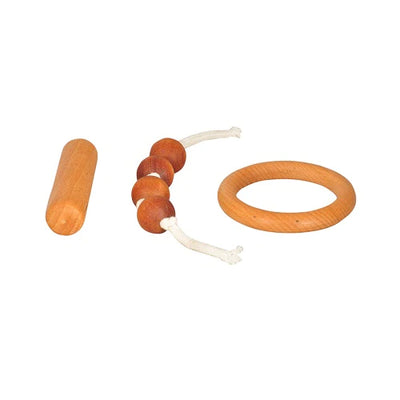
For instance, activities with wooden toys or activity kits, such as sorting blocks by size or assembling puzzles, train the mind in pattern recognition and sequential thinking. These aren't seen as 'studies' but as fascinating challenges, preparing a child for schoolwork without the accompanying stress. It’s about building a robust mental framework through joyful discovery.
Holistic Child Development Toys: More Than Just Academics
Montessori toys are renowned for promoting holistic child development, moving beyond mere intellectual gains to nurture the entire child. They focus on sensory development through materials like the Pink Tower or tactile fabric boxes, which refine discrimination and concentration. Practical life activities, often found in Montessori setups, teach children essential self-care and environmental care skills, boosting their confidence and independence.
From infancy, children engage with materials that support their cognitive, physical, emotional, and social growth. For toddlers aged 1-3 years, this might involve grasping activities, stacking, or pouring, all of which strengthen coordination and self-reliance. This comprehensive approach ensures that children are not only academically ready but also emotionally intelligent and socially adept, a crucial asset in India's diverse family structures, including joint families.
A Smart Investment for Child Development in India
In a country where parents are 'spending lakhs' on education, the notion of 'smart investment child development India' extends beyond coaching classes. Montessori educational materials, available in our main Montessori collection, represent a different kind of investment: one in intrinsic motivation, independent thought, and enduring joy. These durable, open-ended toys often last for years, passing down through siblings or cousins, offering far greater value than fleeting trends.
Instead of disposable plastic items, investing in quality, purposeful Montessori materials ensures that your child has access to tools that genuinely aid their development over time. Grandparents looking for meaningful gifts, or parents planning return gifts for birthdays, will find these toys offer lasting educational benefits, fostering skills that pay dividends throughout a child's life.
How Play-Based Learning Can Reduce Academic Stress in Kids India
One of the most profound benefits of play-based learning is its ability to reduce academic stress kids India commonly experience. When learning is self-directed and engaging, children develop an internal locus of control, meaning they feel responsible for their learning and success, rather than feeling pressured by external expectations.
Studies consistently show that play-deprived children often exhibit higher anxiety levels and lower problem-solving abilities. Montessori's emphasis on allowing children to choose their activities and work at their own pace fosters a love for learning, transforming potential stress into curiosity and engagement. This empowers them to approach academic challenges with a positive mindset, ready to explore and overcome obstacles.
- Montessori toys actively preserve childhood by fostering independent learning amidst academic pressure.
- Purposeful play is crucial for holistic child development, reducing over-reliance on rote academics.
- The Montessori method cultivates skills like concentration and problem-solving through joyful engagement.
- Investing in durable, open-ended Montessori materials offers long-term value for Indian families.
- Child-led play is proven to reduce academic stress and enhance intrinsic motivation in children.
- Integrating Montessori principles at home supports a balanced approach to education and well-being.
What defines a Montessori toy suitable for reducing academic pressure?
A Montessori toy for reducing academic pressure is characterized by its self-correcting nature, open-ended design, and focus on hands-on exploration. These toys empower children to learn at their own pace, fostering intrinsic motivation rather than external performance-based stress.
How do Montessori toys support a child's natural learning pace?
Montessori toys are designed to align with a child's sensitive periods, allowing them to repeatedly engage with materials until mastery is achieved. This child-led approach respects individual learning speeds, building confidence and a genuine love for learning without rushing or comparison.
Are Montessori toys expensive for Indian families?
While initial costs might seem higher than conventional plastic toys, Montessori materials are a smart investment due to their durability, multi-age usability, and timeless educational value. They often replace the need for numerous single-purpose toys, offering long-term value for Indian families.
How can Indian parents integrate Montessori principles at home?
Indian parents can integrate Montessori principles by creating a 'prepared environment' at home, offering child-sized tools, and encouraging practical life skills. Focusing on independent choice, respecting concentration, and providing purposeful toys supports holistic development daily.
What age is best to introduce Montessori toys to balance academics?
Montessori toys are beneficial from infancy, adapting to various developmental stages. Introducing them early helps build foundational skills like concentration and independence, naturally balancing academic preparation with the joy of discovery long before formal schooling begins.