Buying guide
0 - 1 Year Age Toys
Parent's buying guide
How to choose toys for a baby under one year, written for Indian families.
Match the toy to the month, not the year
- A toy that worked for a five-month-old is often too easy for an eight-month-old, and frustrating for a three-month-old.
- Use the age filter to narrow this collection to the current month.
- When in doubt, choose simpler. A baby will go back to a simple toy for weeks before mastering it.
Safety checklist
- Mouthing safe: every toy will end up in the mouth at this age. Non-toxic finish, no loose paint, smooth edges.
- No small parts that could choke: anything that fits through a small open hand is too small.
- BPA-free plastic, splinter-free wood, well-stitched fabric.
- Mobile cords should be strong. The baby will eventually grab and pull.
- Test rattles for being loud enough to enjoy but not so loud they damage hearing (under 70 decibels).
Quality signals to look for
- Solid wood preferred over MDF.
- Hand-rubbed natural oils preferred over high-gloss paint.
- Tight stitching, no loose threads.
- Visible craftsmanship in joints, especially for stacking and mobile toys.
- Made-in-India where the maker can match the Montessori specification.
Budget guidance for the full first year
- 0 to 3 months: one good high-contrast mobile is the foundational purchase, around ₹800 to ₹1,500.
- 3 to 6 months: 2 to 3 grasping items at ₹200 to ₹500 each, plus one second mobile if budget allows.
- 6 to 12 months: one investment toy (push-pull, rocker, interlocking discs) at ₹1,000 to ₹2,500, plus 4 to 6 smaller sensorial items.
- Realistic full-year budget for a thoughtful Indian household: ₹4,000 to ₹7,000. Less is fine, more is rarely better.
Rotation strategy
- Offer 4 to 6 toys at a time on a low open shelf.
- Hide the rest in a basket out of sight.
- Rotate weekly. A 'new' toy after a two-week break feels new again.
- Watch the baby. Boredom or throwing is the signal to swap.
What to skip in the first year
- Battery-operated noise toys (overstimulate, and the baby learns the toy does it for them).
- Bright primary colours before 5 months (the visual system is still building contrast first, then graded colour).
- Toys with screens or moving lights.
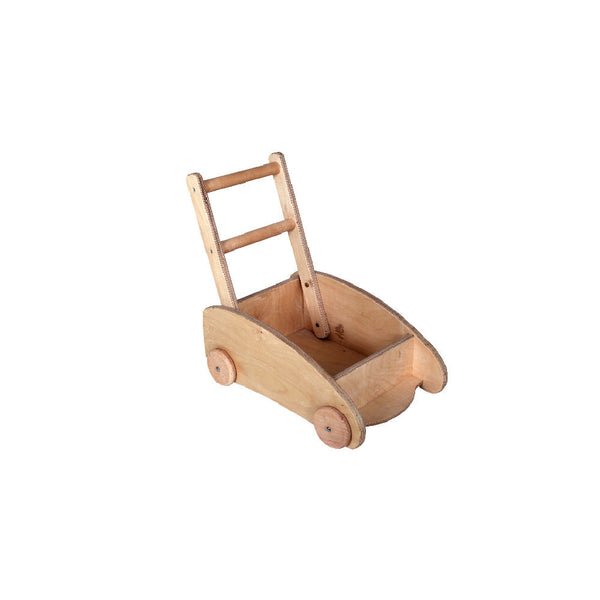
- Walkers on wheels (they slow motor development; choose a push-walker after 9 months instead).
- Anything labelled 'educational' without naming a specific skill it builds.
Special note for Indian homes
- High humidity in coastal regions can swell unsealed wooden toys. Choose well-sealed wood and store dry.
- Indoor air quality: prefer beeswax or natural-oil finishes over chemical varnishes.
- Joint-family homes: choose toys with strong build for cousin rotation over months and years.
Skills this shelf builds
What does a curated 0 to 1 year toy collection actually build? In the first twelve months, the brain is laying down the foundations for every skill that follows.
Visual development
- High-contrast pattern recognition (0 to 3 months): the newborn eye sees strong dark-light contrast best.
- Visual tracking (1 to 4 months): the eye learns to follow a moving object across a 180-degree arc.
- Colour discrimination (3 to 5 months): graded colour appears as the retina matures.
- Depth perception (4 to 7 months): the baby starts to reach for objects at known distances.
- Three-dimensional understanding (6 to 12 months): mobiles become reach-and-grab toys.
Auditory development
- Sound localisation (0 to 3 months): the head turns toward a rattle.
- Rhythmic recognition (3 to 6 months): the baby anticipates a familiar chime or song.
- Associative listening (6 to 12 months): the baby learns that shaking causes the rattle to ring.
Fine motor
- Grasping reflex (0 to 4 months): the palm closes when touched.
- Voluntary reaching (3 to 6 months): the baby reaches for what they see.
- Two-handed object passing (6 to 9 months): a toy moves from left hand to right hand.
- Banging and shaking (6 to 12 months): the baby explores cause-and-effect through hand movement.
- Pincer grip (8 to 12 months): thumb and forefinger meet, a milestone for self-feeding.
Gross motor
- Head control (0 to 3 months): the baby holds the head steady when held upright.
- Tummy time strength (1 to 5 months): neck, shoulder and arm muscles develop.
- Rolling (4 to 7 months): the baby rolls from back to belly and back.
- Sitting unaided (6 to 8 months): the spine takes its first independent load.
- Crawling (6 to 10 months): hands and knees coordinate.
- Pulling to stand (8 to 12 months): leg muscles build.
- First steps (10 to 12 months): for most Indian babies, this comes between 11 and 14 months.
Cognitive
- Cause and effect (3 to 9 months): the baby learns that shaking the rattle makes sound.
- Object permanence (8 to 12 months): the baby understands that a hidden toy still exists.
- Spatial awareness (6 to 12 months): in and out, on and off, near and far.
- Early problem solving (10 to 12 months): the baby works out how to get a toy that has rolled out of reach.
Social and emotional
- Face recognition (0 to 3 months): caregivers' faces are studied intensely.
- Mirror self-recognition (6 to 12 months): the baby smiles at their reflection.
- Joint attention (8 to 12 months): the baby looks where the parent is looking.
- Early communication signals (9 to 12 months): pointing, reaching, babbling.