Homeschooling Curriculum India: Self-Paced Learning Science
When considering a homeschooling curriculum India, many parents are discovering a profound, science-backed approach: self-paced learning, rooted in Montessori principles. This methodology empowers children to learn at their unique speed, fostering not just knowledge acquisition but also crucial developmental skills like focus and independence. This matters because it directly addresses the 'seven-point IQ opportunity' for Indian children highlighted by The Hindu, by systematically nurturing diverse cognitive abilities.
Self-paced learning, in the Montessori context, is a pedagogical approach where a child freely chooses their learning activities, works on them for self-determined durations, and progresses at their own developmental rhythm within a prepared environment. This matters because it aligns with a child's innate curiosity and sensitive periods, leading to deeper engagement and more meaningful retention. Indian parents can create a home environment that respects this natural learning process, moving beyond traditional rote memorization.
The Brain Science Behind Child-Led Exploration
Research consistently demonstrates that a child's brain is wired for exploration. When children are allowed to pursue their interests, their brains activate reward pathways, strengthening neural connections. This intrinsic motivation is far more powerful than external rewards or pressures, leading to sustained attention and deeper cognitive processing – the very essence of child-led learning science.
Maria Montessori observed that children have 'sensitive periods' – windows of intense, almost effortless absorption for specific skills, like language acquisition (18-36 months) or order (1-3 years). A self-paced environment allows a child, say 3-year-old Anya in a Bengaluru apartment, to repeatedly engage with a particular Montessori practical life material, like pouring lentils, until she has fully satisfied that internal drive, building fine motor skills and concentration without interruption.
Montessori at Home: Tailoring Homeschooling Pedagogy for Indian Families
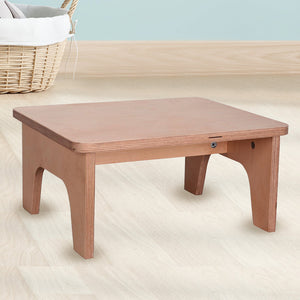
Adopting Montessori homeschooling India doesn't require a sprawling classroom. Even in compact urban homes, a 'prepared environment' can be created. This involves child-sized furniture, accessible materials, and a sense of order. For instance, a small shelf dedicated to activities, rotated weekly, provides choices without overwhelming a child. This approach to homeschooling pedagogy India contrasts sharply with the common pressure to constantly 'teach' children.
Imagine young Rohan, a 4-year-old in a joint family in Pune. Instead of being drilled on numbers, he's freely working with Montessori mathematical materials, counting beads on the golden bead chain, discovering quantity and sequence through hands-on experience. His grandparents, initially questioning this 'play,' soon observe his intense focus and genuine understanding, rather than just reciting numbers by rote. This self-paced engagement respects the child's internal clock for understanding.
Tangible Benefits: Self-Paced Learning Builds Resilient Indian Children
The benefits of self-paced learning extend far beyond academics. Children who learn this way develop superior problem-solving abilities because they are allowed to make mistakes and self-correct, a core Montessori tenet. When a 5-year-old tries to fit the cylinders into the wrong slots and then independently figures out the correct order, she isn't just learning size differentiation; she's building neural pathways for critical thinking and resilience.
Studies indicate that children in self-paced environments exhibit greater independence, self-discipline, and a deeper love for learning. They don't just 'know' facts; they understand concepts, enabling them to transfer knowledge to new situations. This kind of deep, internalised learning prepares children for a future that demands adaptable thinkers, not just good test-takers, ensuring the self-paced learning benefits children for life.
The power of self-correction, often seen in Montessori activities where the material itself gives feedback (like the tower falling if not stacked correctly), is a non-obvious but critical insight. This process builds metacognition—the ability to think about one's own thinking—which is far more valuable than immediate external correction. It teaches children that mistakes are opportunities for learning, fostering a robust internal locus of control often overlooked in traditional curricula.
Embracing self-paced learning within your homeschooling curriculum in India means trusting your child's innate capabilities and providing an environment that nurtures them. Observe your child tonight: what genuinely captivates their attention? Providing resources aligned with those natural interests is the first step towards unlocking their full scientific potential.