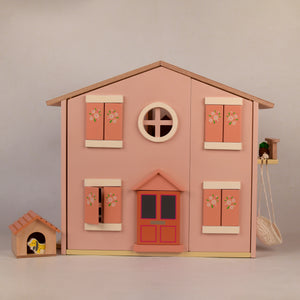
Doll House for Kids: Building Essential Life Skills
A doll house for kids offers a vibrant miniature world where children naturally develop crucial life skills like social interaction, language proficiency, problem-solving, fine motor coordination, and emotional intelligence through imaginative play. This immersive experience prepares them for real-world scenarios, fostering well-rounded development essential for navigating childhood and beyond. It’s more than just a toy; it’s a powerful tool for holistic growth.
In Indian homes, where joint families and close-knit communities are common, a dollhouse can become a hub of learning, reflecting the daily interactions and celebrations children observe. From managing a miniature kitchen during Diwali preparations to navigating sibling squabbles, dollhouse play provides a safe space for children to experiment with life’s complexities.
What is Montessori Dollhouse Play?
Montessori dollhouse play involves providing a realistic, open-ended miniature environment that encourages independent exploration and the development of practical life skills. This matters because it allows children to spontaneously mimic real-world activities, fostering self-reliance and cognitive growth. Indian parents can facilitate this by choosing dollhouses with simple designs and child-sized accessories that promote hands-on engagement.
Nurturing Social Skills and Emotional Intelligence
Child development experts agree that a dollhouse is an exceptional tool for cultivating social-emotional learning (SEL). As children engage in role-play, they step into various characters, learning empathy by understanding different perspectives and practicing conflict resolution. This is particularly relevant in Indian homes, where children frequently interact with multiple generations and learn the nuances of family dynamics.
Research shows that children who engage in dramatic play, like dollhouse scenarios, exhibit higher levels of emotional understanding and cooperation. They can safely express feelings, manage frustration, and develop crucial social etiquette. This aligns with recent insights, such as the Times of India highlighting creative activities for emotional expression, as dollhouse play naturally encourages children to open up emotionally.
Boosting Language Development and Communication
A dollhouse becomes a bustling stage for storytelling and dialogue, significantly enhancing a child's language proficiency. As children invent conversations between their dolls, they expand their vocabulary, practice sentence structure, and develop narrative skills. From inviting a friend for a pretend chai to discussing school plans, every interaction within the dollhouse contributes to robust communication.
Studies indicate that children engaged in imaginative play, particularly with small world setups, use more complex language and engage in extended discourse. This practice strengthens their ability to articulate thoughts, express ideas, and listen actively – essential skills for academic success and confident social interactions within and outside the family.
Sharpening Problem-Solving and Cognitive Abilities
Within the miniature world of a dollhouse, children constantly encounter opportunities for problem-solving. Arranging furniture, deciding where characters will eat or sleep, or even resolving a tiny plumbing issue (imaginary, of course!) all require spatial reasoning and logical thought. This type of play actively engages their cognitive abilities in a fun, exploratory manner.
For instance, a child might try to fit a large doll furniture piece into a small room, learning about dimensions and spatial relationships. These everyday 'problems' in play contribute directly to developing critical thinking skills. This hands-on problem-solving prepares children for real-world challenges, much like exploring puzzles or activity kits, which demand similar cognitive engagement.
Enhancing Fine Motor Skills and Coordination
Manipulating the small figures and accessories within a dollhouse is an excellent exercise for developing fine motor skills and hand-eye coordination. Dressing dolls, arranging tiny teacups, opening and closing miniature doors, or moving characters through rooms all require precision and dexterity. This is akin to the practical life activities championed by Maria Montessori, focusing on purposeful hand movements.
These repeated actions strengthen the small muscles in a child's hands and fingers, which are crucial for later tasks like writing, drawing, and self-care. It's a foundational aspect of development that often goes unnoticed amidst the fun, but is highly valued in Montessori education for its impact on independence and skill acquisition.
Cultivating Creativity and Imagination
The very essence of a dollhouse lies in its ability to spark boundless creativity and imagination. It’s an open canvas where children are the architects of their own stories, building worlds and narratives without limits. This unscripted play allows children to explore different roles, scenarios, and outcomes, fostering a fluid and innovative mindset.
The current emphasis on moving creativity from the margins to the mainstream of learning, as highlighted by Forbes India, underscores the vital role of toys like dollhouses. From creating a bustling Hello Kitty themed home, inspired by new ranges entering India, to designing a traditional Indian household, children are empowered to envision anything. This free-form creativity is a cornerstone of Montessori education and equips children with adaptive thinking for life.
Choosing the Right Doll House for Your Child
When selecting a doll house for kids, consider options that promote open-ended play and are made from durable, natural materials like wood. Look for designs that allow for easy access and manipulation of figures, encouraging independent interaction. A well-designed dollhouse will stand the test of time, adapting to various play scenarios as your child grows.
SkilloToys offers a range of Montessori-aligned learning materials, including dollhouses and accessories, that are thoughtfully designed to support your child's holistic development. Explore our collection at Montessori Method Learning Materials to find the perfect addition to your child's imaginative play toolkit.
A World of Skills in a Little House
Far from being just a whimsical toy, a doll house for kids is a potent educational tool, a miniature universe where essential life skills blossom naturally. From the bustling corridors of social interaction to the quiet corners of emotional understanding, dollhouse play nurtures well-rounded individuals ready for life's journey. Empower your child with this enriching experience and watch their world expand.
- A doll house for kids significantly develops social interaction and emotional intelligence through role-play.
- Dollhouse play is a proven method for boosting language skills and communication in children.
- Children enhance problem-solving and spatial reasoning by arranging and creating scenarios within a dollhouse.
- Fine motor skills and hand-eye coordination are refined through the manipulation of small dollhouse accessories.
- Montessori dollhouses, made from natural materials, promote independent and open-ended creative play.
- Research indicates that engaging with dollhouses helps children process emotions and understand complex social dynamics.
What age is appropriate for a doll house for kids?
Dollhouses are generally suitable for children aged 3 and above, though simpler, sturdier designs can engage toddlers from 18-24 months. Supervision is always recommended, especially with smaller pieces, to ensure safe and enriching play experiences.
How do dollhouses support social-emotional learning?
Dollhouses significantly support social-emotional learning by allowing children to role-play various scenarios, fostering empathy, conflict resolution, and understanding of emotions. This imaginative play helps them process real-world interactions and develop crucial social skills in a safe environment.
Are Montessori dollhouses different from regular ones?
Yes, Montessori dollhouses typically prioritize open-ended play, natural materials, and realistic details that encourage practical life skills and imaginative storytelling without rigid themes. They often focus on simplicity and functionality, allowing the child's creativity to lead the play.
Can dollhouses help with language development?
Absolutely. Dollhouses are powerful tools for language development, as children engage in rich dialogues, create narratives, and expand their vocabulary while articulating scenarios for their characters. This verbalization strengthens communication skills and storytelling abilities.
What are the best materials for a doll house for kids?
Child development experts agree that dollhouses made from natural materials like wood are ideal. These offer a tactile experience, are durable, and align with Montessori principles, promoting sensory engagement and long-lasting play value for your child.