DIY Montessori Continent Box for Geography Fun at Home
Imagine your child pointing to a map, not just seeing shapes, but truly understanding where each part of our incredible planet lies. For many Indian parents, especially those in bustling cities with small apartments, bringing the vastness of the world into a child's learning space can seem daunting. But what if we told you that with a simple DIY Montessori continent box, you can ignite that geographical curiosity right in your living room?
A Montessori continent box is a hands-on, sensorial material designed to introduce young children to the concept of the seven continents. This works because it provides a concrete, tactile representation of abstract geographical concepts, making them tangible and understandable for little hands and minds. Parents can easily create one at home using readily available materials, fostering a love for learning about our world.
Why Geography Matters in Early Years
Geography is more than just memorising names on a map; it's about understanding our place in the world, appreciating diverse cultures, and developing a global perspective. Maria Montessori believed that children possess an absorbent mind, especially between the ages of 0 and 6, making this a prime time to introduce fundamental concepts in a joyful, exploratory way. Early exposure to geography helps build cognitive skills, encourages observation, and lays the foundation for understanding complex environmental and social studies later on. It’s an essential part of comprehensive child development in India and globally.
The Montessori Approach to Geography
In Montessori, learning moves from the concrete to the abstract. Instead of starting with flat maps, children first experience the shapes of continents through puzzles and tactile materials. This method supports children's natural inclination to learn through doing and touching. By manipulating the pieces of a continent box, they begin to form mental images and connections that stay with them. To explore more about this holistic approach, you can delve into our wider collection of Montessori method learning materials.
Crafting Your DIY Montessori Continent Box: Step-by-Step
Creating your own continent box is a wonderful Montessori learning activity that doesn't require expensive supplies. It's a perfect project for a quiet afternoon with your child, even involving grandparents or other family members for a joint family bonding experience.
Materials You'll Need
- A shallow box with compartments, or several small boxes. An old saree box or a Diwali sweet box can be repurposed!
- Cardboard or thick chart paper for continent shapes.
- Fabric scraps or coloured paper in distinct colours for each continent (Montessori tradition often uses green for North America, red for Europe, orange for Asia, brown for Africa, pink for South America, yellow for Australia, white for Antarctica).
- Scissors, glue, and a pencil.
- Optional: Small trinkets or pictures representing each continent (e.g., a tiny elephant for Asia, a kangaroo for Australia, a pyramid for Africa).
Assembly Guide
- Prepare Your Box: If using one large box, you can create dividers with cardboard to form seven compartments. If using separate small boxes, ensure they are uniform in size.
- Draw and Cut Continents: Sketch simplified outlines of each of the seven continents onto cardboard. Don't worry about perfect accuracy; the idea is to capture the general shape. Cut them out.
- Colour-Code: Cover each cardboard continent shape with its designated colour fabric or paper. Glue it neatly. This distinct colour coding is key to the Montessori sensorial experience.
- Label (Optional): For older children, you might write the name of the continent on the back of each piece.
- Populate the Box: Place each coloured continent shape into its corresponding compartment in the box.
Engaging Activities with Your Continent Box
Once your DIY continent box is ready, the real fun begins! Remember to follow your child's lead and introduce activities when they show interest. This is key to effective educational toys for toddlers and preschoolers.
For Younger Children (0-3)
For toddlers, the focus is on sensory exploration and matching. Simply allow them to explore the coloured shapes. You can do a "three-period lesson" by pointing to a continent and saying its name ("This is Asia"), asking them to "Show me Asia," and finally asking "What is this?" as they get familiar. You can also match small toy animals or objects to the continent they belong to, such as a tiger for Asia or a koala for Australia.
For Older Children (3-6)
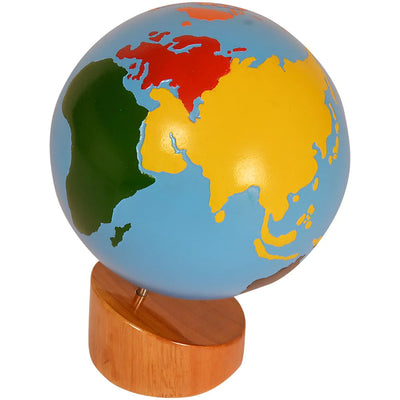
With preschoolers, you can introduce the names of the continents and their positions relative to each other. Use a world map or globe alongside your box. Ask them to place the continents in the correct order or position on a larger mat. You can also introduce simple facts, like "Asia is the largest continent." For further exploration, our Montessori geography materials offer excellent next steps, including continent puzzles and flags.
Integrating Learning with Indian Culture
Bringing in Indian context makes learning more relatable and enriching. When talking about Asia, mention India, our festivals like Diwali, Holi, or Eid, and perhaps family trips to different parts of the country. If you have relatives living abroad, locate their countries on the map within their respective continents. Discuss different foods, traditional clothes, or animals found in various continents. This helps children connect the abstract shapes to their own experiences and the diverse world around them, truly enhancing their child development in India.
For parents looking for ready-made solutions or complementary activities, SkilloToys offers a range of activity kits that can beautifully complement your DIY projects, providing structure and convenience for busy schedules.
Key Takeaways
- A DIY Montessori continent box is an accessible and effective tool for early geography learning at home.
- It introduces continents through hands-on, sensorial exploration, aligning with Maria Montessori's principles.
- Materials can be easily sourced from around the house, promoting sustainability and creativity.
- Activities can be adapted for various age groups (0-6 years), from simple matching to naming and cultural discussions.
- Integrating Indian culture and personal experiences makes learning more meaningful and relatable for children.
- This activity fosters a global perspective and foundational understanding of our world.
FAQ: Your Questions Answered
What age is best for the Montessori continent box?
The Montessori continent box is ideal for children aged 2.5 to 6 years, but younger children can also engage in sensory exploration of the shapes and colours. The activities can be scaled to suit different developmental stages, making it versatile for early childhood learning.
Can I use everyday items for a DIY continent box?
Absolutely! The beauty of DIY Montessori activities is using readily available household items. Cardboard boxes, fabric scraps, old charts, and even repurposed packaging can be used to create an engaging and effective continent box, aligning with a sustainable Indian home.
How does this help my child's development?
Creating and using a continent box enhances fine motor skills, visual discrimination, and cognitive development. It builds a foundational understanding of geography, fosters curiosity about the world, and encourages independent learning and problem-solving, all crucial for holistic child development.
Where can I find more Montessori geography resources?
SkilloToys.com offers a curated selection of authentic Montessori geography materials, including continent puzzles, world maps, and flag sets, to further enrich your child's learning journey beyond your DIY projects. You can explore our collection of Montessori geography materials.
Empowering your child with a love for learning about the world starts with simple, engaging steps. Creating a DIY Montessori continent box is one such beautiful step. For more enriching Montessori educational toys and resources tailored for Indian homes, explore SkilloToys.com.