Make a DIY Potato Stamp Game for Montessori Math Fun
In Indian homes, we've always celebrated resourcefulness and the joy of creating something beautiful from scratch. From traditional remedies passed down through generations to ingenious uses for everyday items, our culture thrives on the 'jugaad' spirit. Today, we're bringing that spirit into your child’s learning journey with a wonderful, hands-on activity: a **DIY potato stamp game**! This simple craft uses readily available materials like potatoes and paint to introduce foundational Montessori math concepts, right in your living room.
Many Indian parents are now exploring Montessori principles to nurture their children's innate curiosity and independence. Creating your own learning tools, like this stamp game, is a fantastic way to align with the Montessori philosophy, even if you're in a small apartment in Bengaluru or a joint family home in Chennai.
What is the Montessori Stamp Game?
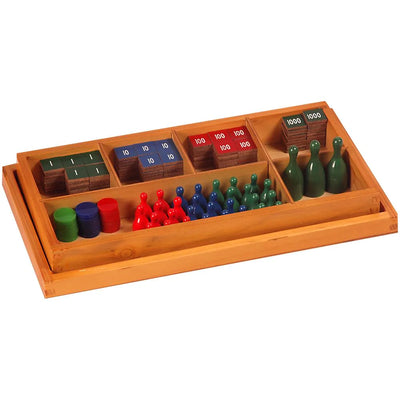
The Montessori Stamp Game is a brilliant tool for helping children understand the decimal system and place value through a concrete experience. It's essentially a miniature representation of the Golden Beads, allowing children to physically manipulate 'units,' 'tens,' 'hundreds,' and 'thousands.'
This material helps children internalise abstract mathematical concepts by allowing them to see, touch, and move quantities. This works because children are naturally drawn to hands-on exploration and learn best by doing. Parents can use it to introduce basic addition, subtraction, and even complex number building. You can explore the authentic Montessori mathematics materials to see how this concept scales up as your child grows.
Why a DIY Potato Stamp Game? The Indian Way of Learning
Why choose potatoes? Beyond their humble presence in every Indian kitchen, potatoes are perfectly suited for DIY stamps. They are soft enough to carve, firm enough to hold their shape, and offer a satisfying tactile experience. This approach perfectly embodies the 'Montessori at home India' ethos – using local, affordable, and sustainable materials to foster learning.
This homemade version encourages creativity and problem-solving, making it an ideal 'educational toy for toddlers' and preschoolers. Plus, involving your child in the creation process (with supervision, of course!) makes the learning even more meaningful.
Gather Your Simple Supplies
You won't need a trip to a specialty store for this. Everything on this list is likely already in your home or easily available at your local market:
- Medium-sized potatoes (one for each value: 1, 10, 100, 1000)
- Kid-friendly paints in specific Montessori colours: green (for units), blue (for tens), red (for hundreds). You can add yellow for thousands if you like!
- A small, sharp knife (for adult use only!)
- A marker pen
- Sheets of paper or a notebook
- Small shallow dishes or plates for paint
Crafting Your Stamps: Step-by-Step Guide
1. Preparing the Potato Blocks
Wash and dry your potatoes. With the marker, draw the symbols you'll be stamping onto the flat side of each potato half. For the '1' (units), you can draw a small dot or a simple square. For '10' (tens), a line. For '100' (hundreds), a larger square or circle. And for '1000' (thousands), a triangle or even a cross.
2. Carving the Stamps (Adult Task)
Carefully, using the sharp knife, cut away the potato around your drawn symbols. You want the symbol to stand proud, like a raised stamp. Ensure the stamping surface is relatively flat. It's okay if they aren't perfect; the charm of DIY lies in its unique imperfections!
3. Assigning Colours and Setting Up
Once your stamps are carved, dry them well. Pour a small amount of each coloured paint into separate shallow dishes. Traditionally, Montessori uses green for units, blue for tens, and red for hundreds. This colour-coding helps children visually differentiate between place values. Set out your paper and stamps, and you're ready to play!
Playing and Learning with Your Homemade Stamp Game
Here are a few ways to engage your child with their new DIY stamp game:
1. Stamping Numbers for Number Recognition
Start simple. Ask your child to stamp the number '3' using the green unit stamp. Then '10' using the blue ten stamp. Progress to stamping '23' (two blue ten stamps and three green unit stamps). This activity reinforces 'number recognition for toddlers' and introduces the concept of quantity.
2. Building Numbers and Understanding Place Value
Write a number like 345 on a piece of paper. Guide your child to stamp the corresponding units (5 green), tens (4 blue), and hundreds (3 red) below it. This is a foundational 'Montessori learning activity' for understanding place value, where the position of a digit gives it its value.
3. Simple Addition and Subtraction
For slightly older children, introduce basic sums. Write '23 + 12 = ?' Have them stamp out '23' then '12' below it, then count the total stamps for each place value to find the sum. This concrete representation makes arithmetic concepts much clearer. You can find more structured activities like these in Montessori activity kits.
Benefits for Your Child's Holistic Development
Engaging with the DIY potato stamp game offers a wealth of developmental benefits:
- Fine Motor Skills: Holding the potato, dipping it in paint, and pressing it onto paper strengthens small hand muscles and improves hand-eye coordination.
- Cognitive Development: Understanding place value, counting, and performing basic arithmetic lays a strong foundation for future mathematical reasoning. This is crucial for 'child development India'.
- Sensory Exploration: The feel of the potato, the texture of the paint, and the visual feedback of the stamped numbers provide a rich sensory experience.
- Concentration and Independence: Children learn to focus on the task at hand and develop a sense of accomplishment as they create numbers and solve problems on their own.
Montessori at Home: Integrating into Indian Life
This activity fits seamlessly into an Indian household. Imagine grandparents helping children carve the stamps, sharing stories as they learn. You could even carve traditional Indian motifs like a diya, a lotus, or a simple rangoli pattern onto extra potato stamps for art, before transitioning to numbers. It's a way to bond, learn, and celebrate our culture, even in a small Mumbai apartment or a spacious family home.
The beauty of Montessori is its adaptability. Using everyday materials not only makes learning accessible but also teaches children the value of what they have around them. For those looking to explore more about the philosophy and its rich array of materials, SkilloToys.com offers a comprehensive range of Montessori method learning materials designed for optimal child development.
Key Takeaways for Your Child's Learning
- A DIY potato stamp game offers a cost-effective and engaging way to introduce Montessori math concepts at home.
- It concretely teaches the decimal system and place value (units, tens, hundreds, thousands).
- The activity enhances fine motor skills, hand-eye coordination, and concentration.
- Using local materials like potatoes aligns with traditional Indian resourcefulness and promotes sustainable learning.
- It encourages parent-child interaction and can be easily adapted for various age groups and math levels.
Frequently Asked Questions
What age is suitable for the potato stamp game?
This DIY stamp game is generally suitable for children aged 3 to 6 years. Younger children (3-4) can focus on simple stamping and number recognition, while older preschoolers (5-6) can use it for place value, addition, and subtraction.
What are the benefits of a DIY Montessori stamp game?
The benefits include developing fine motor skills, understanding abstract math concepts like place value concretely, enhancing concentration, fostering independence, and providing a sensory-rich learning experience using easily accessible materials.
How does this activity help with number recognition?
By physically stamping quantities and associating them with specific symbols and colours, children create a strong visual and tactile memory of numbers. This direct experience helps them recognise and internalise number values far more effectively than rote memorisation.
Can I use other vegetables for stamps?
Yes, you can experiment with other firm vegetables like carrots or capsicums, though potatoes are generally the easiest to carve and offer a good surface area for stamping. Ensure any vegetable used is safe and non-toxic.
How does the Montessori Stamp Game relate to other materials?
The Stamp Game acts as a bridge between the very concrete Golden Bead material and the more abstract written operations. It reinforces concepts learned with materials like the Sandpaper Numerals and prepares children for the Movable Alphabet of numbers, making it a crucial part of the Montessori math sequence.
Embrace the joy of hands-on learning and watch your child's mathematical understanding blossom with this simple, delightful activity. For more inspiration and authentic Montessori resources to support your child's development, visit SkilloToys.com – your partner in nurturing young minds in India.