Montessori Math at Home: Concrete to Abstract Steps
As Indian parents, nurturing our children's curiosity from their early years is paramount. If you’re exploring Montessori at home, you’ll appreciate its unique math approach. The Montessori math sequence, moving from concrete experiences to abstract understanding, makes numbers tangible for young minds right here in our homes.
So, what exactly is this Montessori concrete to abstract math journey? It introduces concepts via physical, manipulable materials children can see, touch, and move. This works because sensory exploration precedes logical reasoning in child development. Parents can replicate this at home by offering hands-on experiences before introducing numerical symbols.
Why Montessori Math Works Wonders for Young Minds
Maria Montessori observed children's natural draw to order and precision. Her materials isolate concepts, letting a child focus on one idea. This self-correcting design empowers independent learning, building confidence and intuitive understanding. It builds a strong foundation, not rote memorisation, invaluable for child development in India.
The Montessori Math Sequence: A Step-by-Step Journey
Let's explore how children gradually move from handling tangible objects to understanding abstract numbers and equations. This sequence respects the child's developmental pace, ensuring a joyful and effective learning experience.
Stage 1: Exploring Quantity with the Senses (Ages 2.5-4 years)
At this stage, focus purely on understanding 'how much'. Children count real objects, matching one item to one number – like idlis or bangles. Number Rods help them visually and tactilely experience quantities 1-10. Sandpaper Numerals then introduce the feel of the number symbol, associating it with the spoken name.
Stage 2: Connecting Quantity to Symbol (Ages 3-5 years)
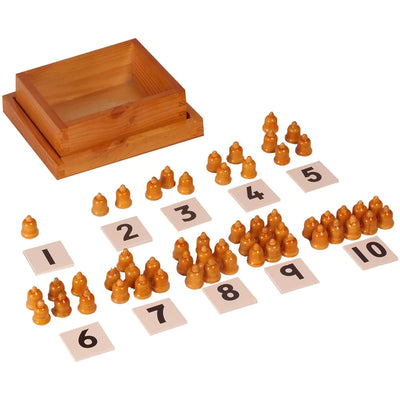
Once a child grasps quantities and recognises numeral symbols, the next step links them. Imagine placing three diyas next to the numeral '3'. Materials like the Spindle Box let children physically place correct quantities into numeral-labelled compartments. This solidifies understanding that a symbol like '5' represents five items, making abstract numbers concrete.
Stage 3: Understanding the Decimal System and Operations (Ages 4-6 years)
With quantities and symbols firm, children are ready to explore larger numbers and operations. The decimal system is introduced hands-on, showing how units combine to form tens, hundreds, and thousands. The Golden Beads are iconic, allowing children to see and feel the difference between units, tens, hundreds, and thousands. They physically carry out basic operations, understanding the 'why' before written sums. This builds a strong mathematical foundation.
Transitioning to Abstraction: The Power of Repetition
The concrete to abstract journey is a gradual transition built on repeated, joyful interaction. As children work with materials, understanding deepens, and the need for physical objects diminishes. They internalise the concept. Indian parents can support this by observing readiness, encouraging exploration, and allowing repetition until mastery. This cultivates genuine mathematical thinking.
Practical Tips for Montessori Math at Home in India
Let's look at some practical ways to integrate Montessori math into your Indian home.
Create a Prepared Environment
Designate a small, accessible space in your home for math materials. This 'prepared environment' encourages independent engagement. Use local materials like pebbles, shells, or small clay balls for counting, making Montessori at home India friendly.
Follow the Child's Lead
Observation is key. Watch your child's interests and introduce concepts when ready. If counting family during Diwali or dividing laddoos fascinates them, that's your cue. Never push, always invite.
Focus on Hands-On Exploration
Montessori math is about doing. Let your child manipulate materials as needed. This tactile engagement helps their brain form strong connections. Quality educational toys for toddlers promoting hands-on learning make a significant difference.
Embrace Errors as Learning Opportunities
In Montessori, errors are not failures but guides. If your child makes a mistake, avoid direct correction. Instead, demonstrate the activity or encourage self-correction. This fosters problem-solving and resilience, like the gentle guidance of grandparents.
Key Takeaways
- Montessori math moves from concrete materials to abstract understanding.
- Stages include quantity exploration, symbol connection, and decimal system introduction.
- Specific materials like Number Rods, Spindle Box, and Golden Beads are key.
- Create a prepared environment; integrate local Indian resources.
- Observe the child, encourage exploration, and allow repetition.
- This approach fosters deep mathematical understanding and confidence.
Frequently Asked Questions About Montessori Math
What age should I start Montessori math with my child?
Pre-math concepts can start at 2.5-3 years via practical life skills. Formal Montessori math materials typically begin around 3 years, progressing with readiness.
Do I need specific Montessori materials for math at home?
While authentic materials are ideal, you can begin with DIY versions. Investing in key materials enhances the experience due to their precise design and self-correcting nature.
How is Montessori math different from traditional math teaching?
Montessori math focuses on understanding through hands-on exploration. Traditional methods often start with abstract symbols and rote memorisation, less engaging for young children.
Can my child learn Montessori math at home without a teacher?
Absolutely! Many Indian parents successfully implement Montessori math at home. Understand the sequence, observe your child, and present materials clearly.
The Montessori math sequence offers a logical path for children to fall in love with numbers, building a robust foundation for a lifetime. Explore high-quality Montessori math materials at SkilloToys.com to support your child’s incredible learning journey.