Montessori Math Sequence for Home Learning
For many of us Indian parents, teaching math to our little ones can feel like a daunting task. We want our children to not just memorize numbers but truly understand them. This is where the brilliant Montessori math sequence comes in, offering a gentle, step-by-step journey from tangible experiences to abstract concepts right within the comfort of your home. It's a method that respects your child's natural pace and curiosity, making numbers a joyful discovery rather than a chore.
The Montessori approach to mathematics is fundamentally about building understanding from the ground up, moving from the concrete to the abstract. This means children first interact with physical, tangible materials that represent numerical concepts. This works because it taps into a child's natural sensory learning, allowing them to see, touch, and manipulate quantities. Parents can facilitate this by introducing materials that isolate specific math concepts, helping their child build a strong foundational number sense.
Laying the Foundation: Practical Life and Early Number Sense
Before numbers on paper, children need to develop a solid understanding of quantity, order, and comparison. In Indian homes, this often begins naturally through daily activities. Counting *rotis* for dinner, sorting different types of lentils with Dadi, or arranging *diyas* for Diwali all contribute to developing crucial early math skills. These practical life activities, a cornerstone of the Montessori method, lay the groundwork for mathematical thinking by fostering concentration and logical sequencing. Explore more about these foundational tools in our Montessori learning materials collection.
Sensory Exploration: Touching and Feeling Numbers
Once a child shows interest in numbers, we introduce them in a sensory way. The Montessori Sandpaper Numerals are perfect for this. Each numeral (0-9) is rough to the touch, mounted on a smooth board. Children trace the numeral with their fingers, feeling its shape while hearing its name. This multisensory experience imprints the symbol in their mind, connecting the visual representation with the tactile sensation, which is incredibly powerful for memory and understanding.
Building Quantity: Connecting Numbers to Objects
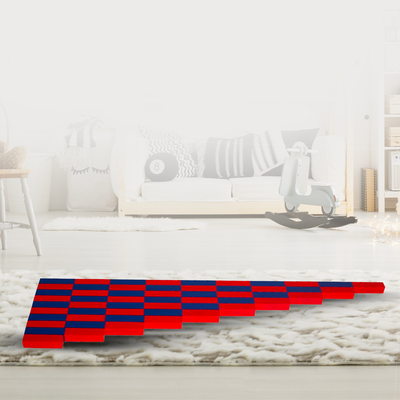
After learning the numeral's symbol, the next step is to connect it to a quantity. The Montessori Number Rods (Red and Blue Rods) allow children to visually and tactilely understand quantities from 1 to 10. They see that the '5' rod is five times longer than the '1' rod, literally experiencing the difference in quantity. Following this, the Spindle Box helps them consolidate the concept of quantity and introduce the idea of zero, where no spindles are placed in the '0' compartment. These types of educational toys for toddlers are crucial for developing one-to-one correspondence and number sequencing.
Moving to Abstraction: The Power of Place Value
As children master the numbers 1-10, the Montessori math sequence gently guides them towards understanding larger numbers and the concept of place value – the cornerstone of our number system. This transition is carefully scaffolded, always starting with concrete representation before moving to more abstract thinking. This holistic approach supports strong child development India parents cherish.
Understanding Large Numbers: The Golden Beads
The Golden Bead material is perhaps the most iconic Montessori math material for understanding place value. It visually and tangibly represents units, tens, hundreds, and thousands. Children hold a single bead (unit), a bar of ten beads (ten), a square of a hundred beads (hundred), and a cube of a thousand beads (thousand). They perform operations like addition, subtraction, multiplication, and division by physically manipulating these beads, literally seeing how numbers grow and shrink. This concrete experience with the decimal system prepares them for understanding abstract arithmetic.
Beyond the Beads: Towards Mental Math
Once the child has a strong grasp of quantity and place value through the Golden Beads, Montessori introduces materials that progressively become more abstract. The Teen and Ten Boards help children understand numbers from 11-19 and 10-90 by combining numerals. The Stamp Game then takes them a step closer to abstract calculations, where stamps represent quantities but are flatter and less dimensional than the beads. This gradual stripping away of the concrete helps the child internalize the concepts, moving towards mental calculation and written arithmetic. This careful progression is why Montessori math is so effective for children learning at home in India.
Integrating Montessori Math in Indian Homes
Bringing the Montessori math sequence home doesn't require a dedicated classroom; it requires a mindset. Look for opportunities within your everyday routine: counting fruits at the *sabzi mandi*, arranging books on a shelf by size, or even using *rangoli* patterns to introduce geometry. In a joint family setting, grandparents can be wonderful storytellers, weaving numbers into tales, or involving children in counting household items. For those in smaller apartments, multi-functional Montessori math materials that can be neatly stored are a boon. Remember, the key is to follow your child's interest and introduce concepts when they are developmentally ready.
Key Takeaways for Montessori Math at Home
- Montessori math progresses from concrete, hands-on materials to abstract concepts.
- Early math skills are built through practical life activities and sensory exploration.
- Materials like Sandpaper Numerals, Number Rods, and the Spindle Box establish number sense for 0-10.
- The Golden Beads are essential for understanding place value and large numbers.
- Gradual abstraction with materials like Teen Boards and the Stamp Game leads to mental math.
- Integrate math naturally into daily Indian home routines and observe your child's readiness.
FAQs About Montessori Math for Homeschooling
What age should I start Montessori math with my child?
You can begin laying foundational math skills as early as 18 months to 2 years through practical life activities like sorting and counting. Formal introduction to materials like Sandpaper Numerals typically starts around 3-4 years, depending on the child's interest and developmental readiness.
Do I need to buy all the expensive Montessori materials for math at home?
While authentic Montessori materials are wonderfully designed, you don't need every single item. Many concepts can be explored using DIY alternatives with household items like buttons, lentils, or pebbles. Focus on understanding the purpose of each material and finding creative ways to achieve the same learning outcome, especially for families practising Montessori at home India.
How is Montessori math different from traditional school math?
Montessori math emphasizes understanding over rote memorization. It starts with tangible, manipulative materials that allow children to physically construct their understanding of mathematical concepts, unlike traditional methods that often begin with abstract symbols on paper. This hands-on approach builds a much deeper and more intuitive grasp of numbers.
My child struggles with numbers. How can Montessori help?
Montessori math is particularly beneficial for children who struggle, as it provides multiple sensory pathways to understanding. The concrete materials make abstract concepts tangible and less intimidating. By allowing children to work at their own pace and repeat activities as needed, it builds confidence and a solid foundation without pressure.
Embracing the Montessori math sequence at home can transform your child's relationship with numbers, turning potential struggles into joyful discoveries. At SkilloToys.com, we are dedicated to providing high-quality, authentic Montessori and educational wooden toys that support your child's incredible journey of learning and growth.