Montessori Number Rods for Early Maths at Home
Many Indian parents, especially those embracing the Montessori approach at home, often wonder how to make early mathematics engaging and meaningful for their little ones. It's a common desire to lay a strong foundation, not just for school, but for a lifelong love of learning. This is where the beauty of Montessori number rods comes into play, offering a brilliant, hands-on way to introduce fundamental number concepts to your child right in the comfort of your living room.
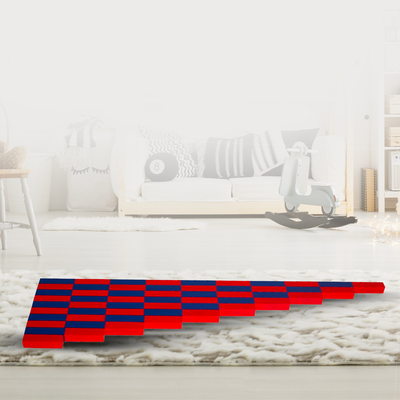
Montessori number rods are a set of ten wooden rods, each progressively longer than the last, and segmented into alternating red and blue sections. The shortest rod is 10 cm (one unit), and the longest is 100 cm (ten units). This material is designed to help children understand the concrete concept of quantity, connecting it directly to numerical value. This works because it provides a visual, tactile, and kinesthetic experience of number. Parents can introduce the rods by showing the child the length difference and associating each rod with its corresponding number.
Why Montessori Number Rods are Perfect for Indian Homes
In the vibrant, often bustling, environment of an Indian home – be it a compact apartment in Bengaluru or a spacious joint family house – creating focused learning opportunities is key. The Montessori number rods fit beautifully into this context, offering a calm, structured activity that can be done individually or even with the gentle guidance of a grandparent.
Hands-on Learning for Concrete Thinkers
Children, especially those aged 3-6 years, learn best by doing and experiencing, not just by listening. The number rods provide a concrete representation of numbers, allowing children to physically hold, compare, and order quantities. This aligns perfectly with the practical wisdom often found in Indian households, where learning by observation and participation is deeply valued for healthy child development India.
Building a Strong Foundation, One Rod at a Time
The genius of Maria Montessori's design lies in moving from the concrete to the abstract. Initially, a child experiences 'one' as a short rod and 'ten' as a long rod. Gradually, they associate these physical lengths with the abstract symbols of numerals. This foundational understanding is crucial for tackling more complex mathematical operations later on, preventing rote memorisation and fostering genuine comprehension. You can find authentic Montessori mathematics materials, including the number rods, to start this journey at home.
Practical Tips for Introducing Number Rods
When introducing the number rods, start by laying them out randomly on a mat, then ask your child to arrange them in order from shortest to longest. Guide them to count each segment on a rod, tracing with their finger as they go. For example, for the rod of 'three', they would touch and count 'one, two, three'. Repeat this process for each rod, helping them associate the spoken number with the physical quantity. This simple activity builds one-to-one correspondence and a clear understanding of sequence.
Integrating Number Rods into Your Daily Routine
Beyond dedicated learning sessions, these versatile wooden toys can subtly enrich your child's daily life. Think of them not just as 'school materials' but as a natural part of their playroom, ready for exploration.
Everyday Counting Opportunities
During festivals like Diwali, you might count diyas using the rods, or while preparing for a family meal, use them to count plates or ladoos. In a joint family setting, children can even count how many family members are present in a room, associating each person with a segment on the rods. Such practical, real-world applications make learning maths fun and relevant, deeply integrating 'Montessori at home India' practices.
Beyond the Mat: Exploring Basic Operations
Once your child is comfortable with counting, the rods can naturally lead into simple addition and subtraction. For instance, placing the 'three' rod and the 'two' rod end-to-end allows them to see that their combined length matches the 'five' rod – a powerful visual for 3 + 2 = 5. This hands-on method helps develop critical thinking and problem-solving skills, essential aspects of 'Montessori learning activities' and 'educational toys for toddlers'.
Key Takeaways
- Montessori number rods provide a concrete, hands-on introduction to numbers 1-10 for children aged 3-6 years.
- They help children build a strong foundation in number sense, quantity, and one-to-one correspondence.
- The rods facilitate the transition of learning from concrete experiences to abstract mathematical concepts.
- Integrating them into daily Indian home routines, like counting during festivals or family activities, enhances engagement.
- They serve as excellent educational toys for toddlers and preschoolers, fostering genuine understanding over rote memorisation.
Frequently Asked Questions
What age is best to introduce Montessori number rods?
The Montessori number rods are typically introduced to children between 3 to 4 years of age. At this stage, children are developmentally ready to grasp concrete concepts of quantity and sequence through hands-on exploration.
How are number rods different from Cuisenaire rods?
While both are coloured rods for maths, Montessori number rods are specifically designed to represent quantities 1-10 with alternating red and blue segments. Cuisenaire rods are typically unsegmented and come in a wider range of colours and lengths, often used for more advanced algebraic concepts.
Do I need formal training to use Montessori materials at home?
No formal training is required. Montessori materials are designed for self-correction and are intuitive. With a little understanding of the purpose and presentation sequence, parents can effectively use materials like the number rods to guide their child's learning journey at home.
How do number rods help with later maths concepts?
By building a solid understanding of quantity and number relationships (like "five is made of three and two"), number rods lay the groundwork for addition, subtraction, multiplication, and division. They help children visualise numerical operations before they encounter abstract symbols.
Can I make my own number rods at home in India?
While the exact dimensions and colour segmentation of authentic Montessori rods are specific, parents can create DIY versions using local wooden strips, bamboo pieces, or even painted cardboard, ensuring they maintain accurate lengths and alternating colours for clear distinction.
Empowering your child with a joyful and profound understanding of mathematics starts with foundational tools like the Montessori number rods. They are more than just a toy; they are a gateway to logical thinking and a love for learning. Explore a wide range of authentic Montessori method learning materials to support your child's growth journey at SkilloToys.com.