Montessori Number Rods: Teach Maths at Home
In many Indian homes, learning often begins with playful exploration. If you're a parent exploring Montessori at home, you've likely heard of the wonderful tools that make abstract concepts tangible. One such foundational material for early mathematics is the Montessori Number Rods. These colourful, segmented rods are more than just toys; they are a brilliant, hands-on way to introduce your little one to numbers and quantities, right from the comfort of your living room, perhaps even with a grandparent watching!
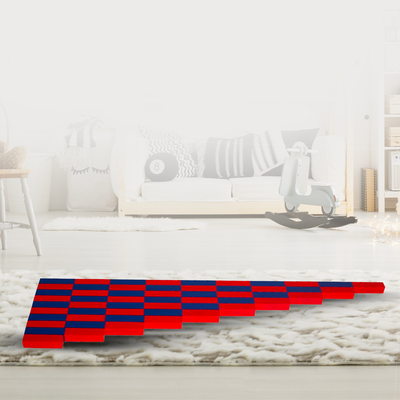
So, what exactly are Montessori Number Rods? They are a set of ten wooden rods, varying in length from 10cm to 100cm, segmented alternately in red and blue. Each segment represents one unit, helping children visually and tactilely understand the concept of quantity from one to ten. This works because it directly connects a physical object (the rod) with its corresponding number, building a strong foundation for abstract mathematical thinking. Parents can easily integrate these rods into daily play, turning learning into an exciting discovery.
Why Montessori Number Rods are Perfect for Indian Homes
In a bustling Indian household, space can sometimes be a premium, but effective learning doesn't require a dedicated classroom. The beauty of Montessori Number Rods lies in their adaptability. They can be laid out on a rug in the living room, a low table, or even on a charpai in the courtyard, making them ideal for Montessori at home India. This material offers a quiet, focused activity that respects your child's natural pace of learning, a principle central to Maria Montessori's philosophy.
Building Foundational Math Skills with Hands-On Learning
The Number Rods are a fantastic starting point for children around 3.5 to 4 years old, or whenever they show an interest in numbers. The initial presentations involve ordering the rods from shortest to longest, teaching children to visually discriminate size and sequence. This simple activity is a powerful pre-mathematical exercise, sharpening their observation skills.
Once the child can accurately order the rods, the next step involves counting each segment as they point, associating the quantity with the verbal number name. For instance, the shortest rod is 'one', the next is 'two', and so on. This tangible experience helps children truly grasp 'how many' rather than just memorising number names. It's one of the most effective Montessori learning activities for number recognition and sequence.
Later, you can introduce number symbols alongside the rods, using small cards with numerals. The child places the numeral '1' next to the 'one' rod, '2' next to the 'two' rod, and so forth. This crucial step bridges the concrete experience of the rods with the abstract symbol, laying the groundwork for reading and writing numbers. You'll find many such impactful Montessori mathematics materials on SkilloToys.com to further support this journey.
Beyond Basic Counting: Exploring Addition and Subtraction
As your child grows confident with numbers 1-10, the Number Rods become versatile tools for introducing basic operations. For addition, you can ask them to find the 'two' rod and the 'three' rod, place them end-to-end, and then find the single rod that matches their combined length – which would be the 'five' rod. This hands-on method makes abstract concepts like 2 + 3 = 5 incredibly clear and engaging.
Similarly, for subtraction, you might take the 'five' rod and ask, 'If we take away the 'two' rod from this, what's left?' They would then find the 'three' rod to match the remaining length. These types of activities make educational toys for toddlers truly come alive, fostering a deep understanding of mathematical relationships rather than rote memorisation.
Remember, the goal isn't speed but understanding. Allow your child to explore at their own pace. Perhaps they might even use their wooden toys to represent numbers during playtime, reinforcing their learning in a fun, imaginative way. Explore our diverse range of wooden toys that complement Montessori learning beautifully.
Integrating Montessori Learning into Your Daily Routine
Incorporating Montessori principles into daily life doesn't require a complete overhaul. Think about how you can use the rods to count during meal prep – 'Can you bring me three tomatoes?' or 'How many rotis did we make today?' These simple integrations help connect the abstract learning with real-world scenarios, crucial for holistic child development in India.
Even during festivals like Diwali or Eid, you can use the rods to count diyas or sweets, making learning part of the cultural fabric. Grandparents, often the first educators in our families, can also enjoy these simple, yet profound, interactions with the children, fostering bonds while subtly nurturing cognitive skills. It’s about creating an enriching environment with readily available Montessori learning materials.
Key Takeaways
- Montessori Number Rods are a concrete, hands-on material for teaching early maths concepts (1-10).
- They help children visually and tactilely understand quantity and number sequence.
- Ideal for homeschooling, adaptable to various home environments, including Indian settings.
- Supports foundational skills like visual discrimination, counting, and number-symbol association.
- Can be used to introduce basic addition and subtraction concepts concretely.
- Integrate learning naturally into daily routines and cultural contexts.
Frequently Asked Questions (FAQs)
What age are Montessori Number Rods suitable for?
Montessori Number Rods are typically introduced to children aged 3.5 to 4 years, or whenever they show readiness and interest in counting and quantities. Observe your child's curiosity – that's usually the best indicator.
How do Number Rods differ from Cuisenaire Rods?
While both are coloured rods for maths, Montessori Number Rods are always segmented to visually represent units, reinforcing the 'how many' concept. Cuisenaire Rods are solid colours and primarily used for more advanced operations and fraction work, making Number Rods ideal for initial quantity understanding.
Can I make Montessori Number Rods at home?
While you can attempt DIY versions using painted wooden dowels, authentic Montessori Number Rods from reputable suppliers like SkilloToys.com are precisely calibrated in length and colour. This precision is vital for the child's accurate perception and learning of quantity and length, making the investment worthwhile.
How can I encourage my child to use the Number Rods?
Present the rods as an invitation to explore, rather than a task. Start with simple activities like ordering them, and allow your child to lead. Make it fun, connect it to real-life objects, and keep sessions short and engaging. Your enthusiasm will be contagious!
Empowering your child's mathematical journey at home is a rewarding experience. With Montessori Number Rods, you're not just teaching numbers; you're building a love for learning and a strong foundation for future academic success. At SkilloToys.com, we are committed to providing high-quality, authentic Montessori materials that support every step of this wonderful journey.