Montessori Number Rods: Teaching Maths at Home
In many Indian homes, the joy of learning often begins with playful exploration, especially when it comes to understanding numbers. As parents, we constantly seek effective ways to introduce complex concepts like mathematics in a simple, engaging manner. This is where the magic of Montessori number rods comes in, transforming abstract counting into a tangible, hands-on experience for young minds. Imagine your little one, not just reciting numbers, but truly 'feeling' the difference between one and ten. It’s an approach perfectly suited for creating a rich learning environment right within your bustling home, whether you live in a spacious house or a cozy apartment in Bengaluru.
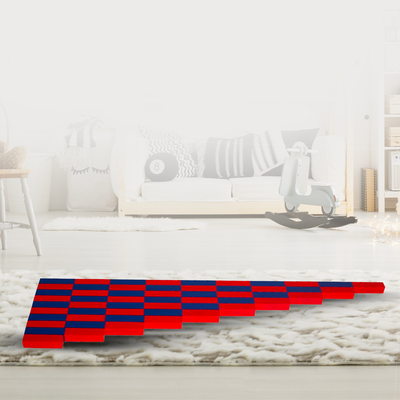
Montessori Number Rods are a fundamental mathematics material developed by Dr. Maria Montessori to help children understand quantities and their corresponding numerical symbols. This educational tool consists of ten wooden rods, each varying in length from 10 cm to 100 cm, painted alternately in red and blue segments. The shortest rod is 10 cm (representing quantity '1'), and the longest is 100 cm (representing quantity '10'). This works because the material provides a concrete, sensorial representation of number values, allowing children to visually and physically compare quantities. Parents can introduce these rods to children typically between 3.5 to 5 years, making early mathematical concepts accessible and intuitive.
Why Montessori Number Rods Work Wonders for Indian Homes
The Montessori approach, with its emphasis on hands-on, self-directed learning, resonates beautifully with the spirit of Indian parenting. Our children often thrive in environments where they can explore and discover at their own pace. Number Rods are fantastic educational toys for toddlers and preschoolers because they offer a multi-sensory experience. Children don't just see the numbers; they touch them, carry them, and arrange them, building a deep understanding that goes beyond rote memorisation. This is particularly valuable in a home setting, where learning can be integrated seamlessly into daily routines, perhaps even with the help of a doting grandparent.
Getting Started with Number Rods: A Step-by-Step Guide
Introducing the Number Rods doesn't require a dedicated classroom; a clean mat on the floor of your living room is perfect. Begin by inviting your child to carry each rod, starting with the shortest. Ask them to identify the 'one rod', then the 'two rod', and so on, associating the quantity with its name. This initial presentation focuses purely on the sensorial experience – the length and the segments. You can lay them out in sequence, creating a visual 'staircase' that immediately shows the progression of numbers.
Once your child is familiar with the sequence and names, you can introduce the numeral cards (separate material) to match with each rod. This bridges the gap between the concrete quantity and its abstract symbol. For example, place the '3' numeral card next to the three-segment rod. This type of Montessori learning activities helps solidify the concept of one-to-one correspondence, a crucial foundation for all future mathematical understanding. Remember, the key is to follow the child's interest and not rush through the stages.
Beyond Counting: Building Deeper Mathematical Understanding
The beauty of the Number Rods extends beyond simple counting. They are excellent for introducing basic arithmetic operations. For instance, to teach addition, your child can place the '2' rod and the '3' rod end-to-end and then find which single rod matches their combined length (the '5' rod). This tangible demonstration makes concepts like 2 + 3 = 5 incredibly clear and intuitive. It's a powerful way to foster early child development in India, ensuring children build a strong foundation in maths with confidence.
Similarly, subtraction can be introduced by showing how removing a section of a rod leaves a smaller quantity. These concrete experiences are vital before moving to abstract equations. The rods also help develop spatial awareness, problem-solving skills, and concentration, which are all integral to holistic development.
Integrating Montessori at Home: Tips for Indian Parents
Creating a Montessori-friendly environment in an Indian home means adapting principles to our unique cultural context. Perhaps you have a small space? No problem! The Number Rods can be stored neatly when not in use. In a joint family setup, grandparents can also be wonderful facilitators, sharing stories and gentle guidance as the child works with the materials. Consider creating a dedicated 'work mat' for your child, perhaps even one made from local fabric, to define their learning space.
Encourage independence by allowing your child to choose when they want to work with the rods and to put them away when finished. This fosters responsibility and a sense of ownership over their learning journey. Incorporating wooden toys like the Number Rods aligns well with the Montessori philosophy of using natural, durable materials that are aesthetically pleasing and safe for children. Embracing Montessori at home India is about nurturing a love for learning, not about replicating a classroom.
Key Takeaways
- Montessori Number Rods offer a concrete, hands-on way to teach numbers 1-10 and basic arithmetic.
- They help children understand quantities visually and tactilely, building a strong mathematical foundation.
- Introduction involves naming rods by length, then matching them with numeral cards.
- The rods effectively demonstrate addition and subtraction through physical manipulation.
- Integrating them at home is adaptable to Indian family structures and living spaces, promoting independent learning.
Frequently Asked Questions
What age is best for introducing Montessori Number Rods?
Montessori Number Rods are typically introduced to children between 3.5 to 5 years old. This age range is ideal as children are developmentally ready to grasp concrete number concepts and engage in focused, purposeful activities.
How do Number Rods differ from regular counting blocks?
Unlike generic counting blocks, Montessori Number Rods are precisely calibrated to represent specific quantities (1-10) with distinct lengths and alternating colours. This design offers a built-in control of error and a clear, sequential progression that fosters an intuitive understanding of number values.
Can I make DIY Number Rods at home?
While DIY versions can be a good starting point, it's crucial that homemade rods are accurately measured and consistent in length and colour segments. The precision of the original Montessori material is key to its effectiveness in conveying exact quantities and relationships, which can be challenging to replicate perfectly at home.
How often should my child work with Number Rods?
Allow your child to choose when and for how long they engage with the Number Rods. Observe their interest; some children may work with them daily for short periods, while others might prefer less frequent, longer sessions. The key is to follow their lead and ensure it remains an enjoyable, self-chosen activity.
Where can I find quality Montessori maths materials in India?
For authentic and high-quality Montessori mathematics materials, including the Number Rods, you can explore trusted providers like SkilloToys.com. We offer a curated selection of educational resources designed to support your child's learning journey at home.
Bringing Montessori mathematics into your home with materials like the Number Rods is a beautiful way to nurture your child's innate curiosity and build a robust foundation for lifelong learning. At SkilloToys.com, we are dedicated to providing Indian parents with thoughtfully designed, high-quality educational tools that make learning an adventure for every child.