Montessori Number Rods: Teaching Maths at Home
In the bustling energy of an Indian home, where learning often blends seamlessly with everyday life, finding engaging ways to introduce foundational concepts to our little ones is key. Many parents are exploring Montessori at home India, seeking methods that resonate with a child's natural curiosity. One such powerful tool for early mathematics is the set of Montessori number rods – a tactile, visual material designed to make abstract numbers tangible for young minds.
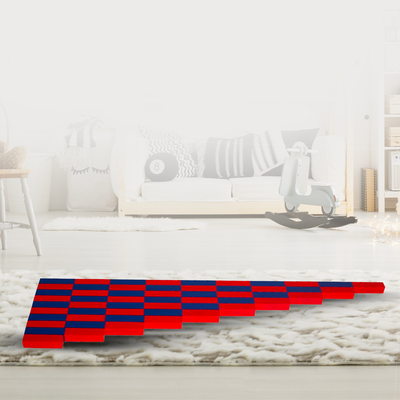
So, what exactly are Montessori Number Rods? This classic Montessori mathematics material consists of ten wooden rods, each a different length and segmented into alternating red and blue sections. The shortest rod is 10 cm long and solid red, representing the number 'one'. Each subsequent rod increases in length by 10 cm and has an additional red and blue segment, up to the longest rod which is 100 cm and represents 'ten'. This works because it provides a clear, sensorial representation of quantity, allowing children to see and feel the difference in length and count each segment. Parents can use these rods to introduce counting, one-to-one correspondence, and basic arithmetic in a concrete, understandable way.
Setting Up Your Maths Nook at Home
Even in a cosy apartment or a joint family home with limited space, creating a dedicated area for Montessori learning activities is entirely possible. You don't need a separate classroom; a clean mat on the living room floor, a low shelf in the children's bedroom, or even a quiet corner of the study table can become your child's 'maths nook'. Ensure the space is clutter-free and inviting, perhaps with a small, child-sized table and chair if available, or simply enough room to spread out the number rods on the floor. Involving older siblings or even grandparents in setting up this space can add to the charm and make it a family affair.
Remember, the beauty of Montessori lies in preparation. Having the number rods easily accessible and neatly arranged encourages independence and exploration. When selecting educational toys for toddlers and preschoolers, opting for durable, natural materials like those found in wooden toys often provides a richer sensory experience, aligning perfectly with the Montessori philosophy.
Step-by-Step with Number Rods: Engaging Activities
Introducing the Rods: The First Steps
Begin by simply inviting your child to explore the rods. Lay them out in a jumbled pile and let them touch, lift, and examine each one. You might notice them naturally arranging them from shortest to longest. This is their direct experience, building a foundation without explicit instruction. Once they've had this free exploration, show them how to arrange the rods in order, creating a visual 'staircase' from one to ten.
Counting and One-to-One Correspondence
After arranging the rods, point to the shortest rod (the 'one' rod) and say, "This is one." Then, point to each segment of the second rod and count, "One, two." Continue this process up to the 'ten' rod. The alternating red and blue segments are crucial here, as they visually break down each rod into individual units, making one-to-one correspondence intuitive. You can then ask your child to count the segments on a particular rod, linking the quantity to the visual representation.
Understanding Quantity and Numerals
Once your child is comfortable counting the segments, you can introduce the actual numerals. Lay out the rods in order and, using separate numeral cards (or even handmade chits), place the corresponding numeral next to each rod. For instance, the rod representing "three" gets the numeral '3' next to it. This activity helps bridge the gap between the concrete quantity (the rod) and the abstract symbol (the numeral), a vital step in child development India's educational journey.
Early Addition and Subtraction: Simple Fun
The number rods are excellent for introducing basic arithmetic. To teach addition, take the 'two' rod and the 'three' rod. Place them end-to-end and ask your child to find which single rod matches their combined length. They will discover it's the 'five' rod, thereby understanding that two plus three equals five. Similarly, for subtraction, start with a longer rod, cover a portion of it with your hand or another smaller rod, and ask them to identify the remaining length. These hands-on exercises make maths less intimidating and more like a playful discovery.
Incorporating Indian Context
Bring in elements from your daily Indian life! After counting the segments on the rods, count similar items at home: the number of laddoos on a plate, the flowers for puja, or even the number of family members present for chai. During festivals like Diwali or Ganesh Chaturthi, use the rods to count diyas or modaks. This contextual learning makes the abstract concepts of quantity truly meaningful and relevant for your child.
Why Montessori Maths Works for Indian Children
The Montessori approach to mathematics, exemplified by materials like the number rods, is built on a foundation of concrete learning before moving to abstraction. This method fosters independence, critical thinking, and a deep, intuitive understanding of numbers rather than rote memorisation. For children in India, where learning often involves a blend of traditional and modern approaches, Montessori provides a strong, child-centred alternative. It encourages problem-solving, builds concentration, and nurtures a lifelong love for learning – crucial skills for any child's development.
Exploring a wider range of Montessori method learning materials can further enrich your child's educational journey, supporting holistic growth across various developmental milestones.
Key Takeaways
- Montessori Number Rods are a sensorial tool for teaching early math concepts to young children.
- They help children visually and tactilely understand quantity, counting, and numerical values.
- Setting up a simple, dedicated 'maths nook' at home encourages independent learning.
- Activities include arranging rods, counting segments, linking to numerals, and basic addition/subtraction.
- Incorporating Indian contexts makes learning relatable and enhances engagement.
- This method fosters deep understanding, concentration, and a love for mathematics.
What age is best to introduce Montessori Number Rods?
Montessori Number Rods are typically introduced to children between 3.5 to 5 years old. However, some children may show interest earlier, around age 3. Observe your child's readiness and curiosity about numbers.
How often should we use the Number Rods?
Short, focused sessions (10-15 minutes) a few times a week are more effective than long, infrequent ones. Follow your child's lead; if they are engaged, continue, but stop before they lose interest to keep it positive.
Can I make DIY Montessori Number Rods at home in India?
Yes, you can create DIY versions using painted wooden planks or even sturdy cardboard strips. Ensure accurate lengths and clear red and blue segments to maintain the material's sensorial integrity for effective learning.
What are the next steps after mastering the Number Rods?
After mastering the Number Rods, children can move on to materials like the Sandpaper Numerals for numeral recognition, Spindle Boxes for associating quantity with symbols, and the Coloured Bead Stairs for exploring quantities up to ten in a linear fashion.
We hope this guide inspires you to explore the wonderful world of Montessori mathematics at home. For authentic and high-quality Montessori materials, visit SkilloToys.com – your trusted partner in child-centric learning.