Pretend Play: Building Math Thinking in Young Children
Picture this: your little one is bustling about, pretending to be a chef in a make-believe kitchen, meticulously sorting "vegetables" by colour and counting out "rotis" for everyone. Or perhaps they’re a busy shopkeeper, arranging their wares and accepting pretend money. It might look like just innocent fun, but did you know pretend play directly builds mathematical thinking in children?
Yes, those imaginative scenarios are powerful engines for developing crucial early math skills, often without your child even realising it! At SkilloToys, we believe in the magic of hands-on learning, and pretend play is a cornerstone of this philosophy, perfectly aligning with Montessori principles of discovery and self-directed activity.
Pretend play, also known as imaginative or dramatic play, is when children use objects, actions, or ideas to represent other objects, actions, or ideas. This works because children are actively experimenting with concepts in a concrete way, moving from abstract ideas to tangible experiences. Parents can foster this by providing open-ended materials and a supportive environment for their child’s creativity to flourish.
The Hidden Math in Everyday Pretend Play
From the moment they start exploring the world, children are naturally curious. Pretend play offers a safe space for them to practice and internalise mathematical concepts that will serve as foundational building blocks for later learning.
Counting and One-to-One Correspondence
When your child serves two idlis for you, one for Papa, and one for themselves, they are engaging in one-to-one correspondence and basic counting. Distributing colourful bangles during a pretend festive celebration or ensuring each teddy bear gets an equal share of "laddoos" reinforces these vital numeracy skills in a practical, meaningful way.
Sorting and Classification
Sorting "spices" in a play kitchen or categorising various items in a pretend grocery store teaches children about attributes like colour, size, and type. This mirrors the work children do with Montessori sensorial materials, like sorting colour tablets or geometric solids, laying the groundwork for logical reasoning and data organisation. It’s a wonderful Montessori learning activity for educational toys for toddlers.
Patterning and Sequencing
Lining up toy cars from smallest to largest, setting the table in a specific order for a pretend family meal, or even creating a simple rangoli pattern with colourful pulses during Diwali preparations, all introduce patterning and sequencing. These activities help children predict, anticipate, and understand order, essential for algebraic thinking later on.
Developing Spatial Awareness and Geometry Through Play
Math isn't just about numbers; it's also deeply rooted in understanding space and shapes. Pretend play is an excellent avenue for this exploration.
Understanding Shapes, Sizes, and Positions
Building a fort with cushions, constructing a "house" for dolls using blocks, or fitting various shapes into a puzzle during imaginative play helps children grasp concepts of geometry. They learn about squares, circles, triangles, and how different shapes interact. This is similar to how children explore dimensions and shapes with Montessori materials like the Pink Tower or Geometric Cabinet.
Through directives like "put the ball under the table" or "place the cup next to the plate," children internalise positional language. This spatial vocabulary is crucial for developing an understanding of geometry and problem-solving in a three-dimensional world, fostering `child development India` from a young age.
Problem-Solving and Logic: The Montessori Way
Beyond explicit math concepts, pretend play hones a child's ability to think critically and solve problems – skills that are fundamental to mathematical intelligence.
Whether they are figuring out how to balance a wobbly tower, devising a way to "mend" a broken toy as a doctor, or calculating how many "cookies" they need to bake for a tea party, children are constantly engaged in practical problem-solving. These scenarios encourage logical reasoning and creative solutions, mirroring the self-correction and purposeful activity central to the Montessori method.
Practical Tips for Parents in Indian Homes
Incorporating mathematical pretend play into your `Montessori at home India` environment is simpler than you might think. You don't need elaborate setups; everyday objects from your Indian home can become incredible learning tools.
Use local, accessible materials: old sarees or dupattas can become capes or tents, steel kitchen utensils can be pots and pans for a pretend feast, and dried legumes or spices can be sorted and counted. Even in smaller apartments, a dedicated corner with a mat and a few props can transform into a vibrant play zone.
Involve family members! Grandparents, or Dadi and Nani, can be wonderful participants in pretend scenarios. Imagine them playing the role of a customer in your child's "vegetable market" or helping sort coins during a pretend bank transaction. This enriches the experience and strengthens family bonds.
Offer open-ended materials that can be anything a child imagines. A set of simple wooden blocks, colourful scarves, or a collection of natural objects like pebbles and leaves can spark endless mathematical adventures. Explore our Activity Kits at SkilloToys for inspiration that encourages creativity and open-ended play.
SkilloToys Recommends: Enriching Mathematical Journeys
While open-ended play is invaluable, thoughtfully designed Montessori materials can further enhance your child's mathematical exploration. Our Montessori Mathematics Materials are crafted to introduce concepts like quantity, counting, and operations through hands-on, engaging activities, building upon the foundations laid by pretend play.
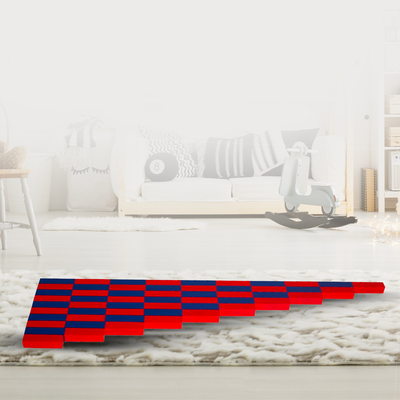
From the Red Rods to the Golden Beads, these materials provide concrete representations of abstract mathematical ideas, perfectly complementing the imaginative worlds children create. You can explore our full range of `Montessori learning activities` and educational resources designed for holistic `child development India` in our comprehensive Montessori Method Learning Materials collection.
Key Takeaways
- Pretend play is not just fun; it's a powerful tool for developing fundamental mathematical thinking in children.
- Through imaginative scenarios, children naturally practice counting, sorting, patterning, and sequencing.
- Pretend play significantly enhances spatial awareness and geometric understanding, crucial for comprehensive math skills.
- It fosters problem-solving and logical reasoning, core elements of mathematical intelligence.
- Simple, everyday objects and family involvement in Indian homes can effectively support mathematical pretend play.
Frequently Asked Questions About Pretend Play and Math
How does pretend play help with early math skills?
Pretend play allows children to physically manipulate objects and act out scenarios that involve counting, sorting, measuring, and understanding patterns. This hands-on experience helps them internalise abstract mathematical concepts in a concrete and memorable way.
What kind of toys encourage mathematical pretend play?
Open-ended toys like building blocks, play kitchen sets, sorting games, dollhouses, and dress-up clothes are excellent. Everyday items like bowls, spoons, pebbles, and dried pulses also make fantastic props for fostering educational toys for toddlers and imaginative mathematical play.
Can I practice Montessori at home India using pretend play?
Absolutely! Montessori principles emphasize real-world experiences and self-directed learning, which pretend play perfectly aligns with. By providing a prepared environment with child-sized tools and opportunities for imaginative role-playing, you can easily integrate `Montessori at home India` through pretend play.
At what age should I encourage pretend play for math development?
Pretend play typically emerges around 18 months to 2 years and grows in complexity. You can start encouraging it as soon as your child shows interest, providing simple props and joining in their imaginative worlds to naturally introduce and reinforce early mathematical concepts.
Is pretend play just for fun, or does it have real educational value?
While immensely fun, pretend play offers profound educational value, especially for cognitive development. It's a critical mechanism through which children make sense of the world, develop language, emotional intelligence, and, as we've explored, robust mathematical thinking.
At SkilloToys.com, we are passionate about nurturing curious minds through purposeful play. Explore our curated selection of Montessori-inspired educational toys for toddlers and materials designed to make learning a joyful journey for your child. Discover the potential within every game, every story, and every moment of imaginative exploration.