Pretend Play Builds Math Thinking in Young Children
Remember those endless hours spent playing 'ghar-ghar' or 'dukaan-dukaan' as a child? As parents, we often see our little ones immersed in imaginary worlds, bustling about with miniature kitchens or toy vehicles. It's delightful to watch, but here’s a fascinating insight for all you parents exploring Montessori at home in India: did you know pretend play directly builds mathematical thinking in children? Yes, those seemingly simple games are powerful learning opportunities, laying crucial foundations for abstract mathematical concepts even before formal schooling begins.
Pretend play, often called imaginative or dramatic play, is when children act out scenarios and roles, using objects symbolically. This seemingly simple activity works wonders because it engages multiple cognitive functions simultaneously – problem-solving, sequencing, measurement, and classification. Parents can encourage this by providing open-ended toys and a supportive environment, allowing their child's imagination to flourish.
The Montessori Link: Learning Through Play
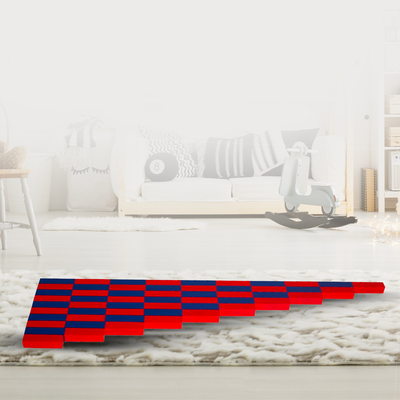
Maria Montessori herself understood that children learn best by doing, by engaging their senses and their hands. While traditional Montessori materials like the Pink Tower or Red Rods directly teach concepts of size and sequence, pretend play offers a parallel, child-led pathway to grasp similar ideas. It's about taking the concrete experiences and applying them in an imaginative context, which is key for deeper understanding and aligns beautifully with the Montessori philosophy.
Counting, Sorting, and One-to-One Correspondence
Imagine your child running a toy shop in your living room, perhaps selling tiny 'fruits' (pebbles from the garden!) or 'sweets' (small blocks). They’re naturally engaging in counting ("How many apples do you want?"), sorting ("Let's put all the red things here"), and one-to-one correspondence ("One coin for one sweet"). These are fundamental mathematical skills. Whether it’s sharing imaginary laddus with family members or dividing up toy cars among friends, they are practicing division and fairness, even without knowing the terms.
Understanding Quantity and Measurement
When your child pretends to bake a cake, they're often 'measuring' ingredients – 'a big spoon of flour,' 'a little bit of sugar.' While not precise, they are developing an intuitive sense of quantity, volume, and comparison. Pouring water from one container to another during bath time play, or arranging toy vehicles from biggest to smallest, reinforces concepts of capacity and seriation. This is crucial for developing spatial reasoning, a cornerstone of mathematical thinking. Explore our range of Montessori Mathematics Materials to see how these abstract concepts are made concrete.
Problem-Solving and Logical Sequencing
Every pretend play scenario involves a series of steps and challenges. If a child is pretending to be a doctor, they must 'diagnose' a patient, 'prescribe' medicine, and 'treat' them – a logical sequence of events. When building a pretend fort, they encounter spatial problems: 'Will this pillow fit here?' or 'How can I make the roof stable?' These are all exercises in logical thinking and problem-solving, skills directly transferable to mathematical problem-solving. This makes pretend play a wonderful way to foster activity kits that support sequential thinking.
Recognizing Patterns and Shapes
From arranging colourful beads to create a pretend necklace for Diwali, to setting up a play kitchen with dishes in a specific order, children instinctively look for and create patterns. This pattern recognition is a core mathematical skill. Furthermore, when they build with blocks or draw imaginary houses, they are interacting with various geometric shapes, learning their names and properties in a natural, hands-on way. This is particularly valuable for Montessori learning activities at home in India, where space might be limited, but imagination knows no bounds.
Nurturing Mathematical Minds in Indian Homes
In our vibrant Indian homes, where joint families often mean multiple generations sharing spaces, pretend play can thrive. Grandparents often have stories to share, sparking imagination, and everyday items like saree fabrics, old utensils, or even spice boxes can become props for rich imaginative scenarios. This informal, organic learning environment complements structured Montessori activities beautifully, offering a holistic approach to child development in India. Remember, educational toys for toddlers don't always need to be fancy; sometimes, the simplest things ignite the biggest learning.
Practical Tips for Parents
Encourage open-ended play: Provide materials that can be many things, like scarves, blocks, or empty boxes. Engage with them: Ask open-ended questions like 'What are you making?' or 'What happens next?' Don't dictate the play, but be a supportive participant. Create a dedicated space: Even a small corner in an apartment can become a 'pretend play zone' with a few props. Rotate toys regularly to keep interest alive, and remember that the process is more important than the perfect outcome.
Key Takeaways
- Pretend play, like "ghar-ghar" or "dukaan-dukaan," directly develops mathematical thinking in young children.
- It fosters essential math skills such as counting, sorting, one-to-one correspondence, and understanding quantity.
- Imaginative scenarios encourage logical sequencing, problem-solving, and spatial reasoning.
- Children learn about patterns, shapes, and measurements through their self-directed play.
- Montessori principles of hands-on, experiential learning are mirrored in the benefits of pretend play.
- Simple, open-ended materials and a supportive environment in Indian homes are key to encouraging this development.
Frequently Asked Questions
What is the ideal age for children to engage in pretend play for mathematical thinking?
Children naturally begin engaging in simple pretend play around 18 months, with more complex scenarios developing between ages 3-6 years. This period is crucial for building foundational mathematical concepts through imaginative role-playing and exploration.
How can I encourage pretend play if my child prefers structured activities?
Start small by introducing open-ended toys alongside their structured materials, like blocks with a sorting tray. Join in their play initially, modeling imaginative scenarios without dominating. Over time, gently encourage them to lead the narrative and explore possibilities.
Do specific toys enhance mathematical thinking in pretend play?
While any open-ended toy can work, items like play kitchen sets, building blocks, measuring cups, and play money naturally lend themselves to mathematical concepts. Materials that encourage sorting, counting, and pattern creation are particularly beneficial for Montessori learning activities.
How does pretend play differ from formal math education in building skills?
Pretend play offers an intuitive, self-directed, and intrinsically motivated approach to math concepts, allowing children to experiment and discover without pressure. Formal education builds on these foundations with structured lessons, but pretend play provides the joyful, hands-on experience that makes abstract concepts tangible.
Can pretend play also help with other aspects of child development in India?
Absolutely! Beyond math, pretend play significantly boosts language development as children narrate stories, enhances social-emotional skills through role-playing and empathy, and sharpens creativity and problem-solving abilities. It’s a holistic developmental tool especially relevant for child development in India where social interaction and storytelling are often central to upbringing.
So, the next time you see your little one deeply engrossed in their make-believe world, remember they're not just playing; they're building a strong foundation for mathematical thinking and lifelong learning. At SkilloToys.com, we believe in supporting every child's innate potential through thoughtfully designed educational toys and resources. Happy playing, happy learning!