Teaching Maths at Home with Montessori Number Rods
As parents in India, we often dream of giving our children the best start, especially when it comes to foundational skills like mathematics. But how do you make maths feel less like a chore and more like an exciting discovery, especially in the busy hum of an Indian household? The answer often lies in hands-on, engaging methods, and that's where using Montessori number rods at home truly shines. They transform abstract numbers into something tangible, inviting your little one to explore quantity and sequence with joy.
Many Indian families are embracing Montessori at home, recognising its profound impact on child development. It’s about more than just numbers; it’s about nurturing a natural love for learning. With a bit of guidance, you can introduce your child to early mathematical concepts using these wonderful tools, even in a cozy apartment or a lively joint family setting.
What Are Montessori Number Rods and Why Do They Work So Well?
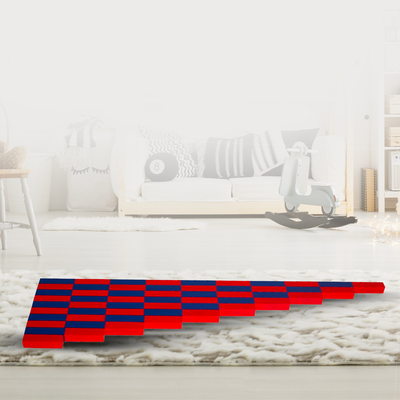
Montessori Number Rods are a set of ten wooden rods, varying in length from 10 cm to 100 cm. Each rod is painted in alternating red and blue sections, with each section representing one unit of measurement.
This material is designed to help children understand the concept of quantity in a concrete way, linking it directly to physical length. This works because it moves from the concrete experience of touching and seeing different lengths to the abstract understanding of what 'one' or 'ten' truly means. Parents can use these rods to introduce counting, sequencing, and even basic arithmetic operations, providing a solid foundation for mathematical thinking.
Why Montessori Number Rods are a Game-Changer for Early Maths
In a world increasingly focused on digital learning, the tactile experience offered by Montessori materials is invaluable. Number rods provide a multi-sensory approach to maths, engaging sight, touch, and even sound as children count aloud. This holistic engagement makes learning deeper and more memorable.
For children aged 3-6 years, who are in the sensitive period for order and developing logical thought, the rods offer a structured yet self-correcting pathway to understanding numbers. The alternating red and blue segments not only make counting easier but also visually reinforce the concept of individual units. This method respects the child's natural pace of learning, fostering concentration and independence, essential skills for any learner in India and beyond.
Practical Activities with Your Child at Home
Integrating Montessori number rods into your home routine doesn't require a dedicated classroom. A quiet corner in the living room or a mat spread out on the floor is often enough. Here are some engaging activities to get started:
Introduction to Quantity and Association
Begin by simply laying out the rods from shortest to longest on a mat. Encourage your child to observe the differences in length. Then, point to the shortest rod and say, "This is one." Ask your child to trace their finger along the rod as they count the red and blue sections.
Move on to the next rod, "This is two," and so on. The goal is for the child to associate the length of the rod with its corresponding quantity, building a strong visual and tactile understanding of numbers. You can relate this to counting small things around your Indian home, like the number of spoons on the dining table or diyas during Diwali.
Exploring Number Names and Symbols
Once your child is comfortable with the quantities, introduce the corresponding number symbols. You can use separate number cut-outs or Montessori mathematics materials like sandpaper numbers. Place the symbol "1" next to the "one" rod, "2" next to the "two" rod, and so forth.
This activity helps bridge the gap between the concrete quantity (the rod) and its abstract representation (the numeral). It’s a crucial step in developing number sense, allowing children to match the quantity they feel and see with the number they read. Practice tracing the sandpaper numbers to engage their sense of touch further.
Laying the Foundation for Addition and Subtraction
The number rods are excellent for introducing basic arithmetic. To teach addition, take the 'one' rod and the 'two' rod. Place them end-to-end and ask your child to find the rod that matches their combined length (the 'three' rod). This visual representation makes addition incredibly intuitive.
Similarly, for subtraction, you can place a longer rod, say the 'five' rod, and cover a portion with a smaller rod, like the 'two' rod. Ask your child to identify the remaining length. These hands-on explorations, perhaps using other high-quality wooden toys as counters, make abstract operations concrete and understandable for young minds.
Creating a Nurturing Learning Space in Your Indian Home
You don't need a sprawling villa to set up a Montessori-friendly space. A small, uncluttered area in your living room or a balcony can become your child's learning corner. Ensure the materials are accessible to your child on a low shelf, fostering independence. Involve grandparents in the learning process; their stories and gentle guidance can enrich the experience even further.
Remember, the focus is on the child's engagement, not on perfect execution. Make learning a natural part of daily life, perhaps by counting the steps to the kitchen or the number of rotis for dinner. Explore a wider range of Montessori learning materials to complement your number rods and enrich your homeschooling journey.
Key Takeaways for Parents
- Montessori Number Rods offer a concrete, hands-on approach to early maths concepts.
- They help children aged 3-6 years build a strong understanding of quantity, sequence, and basic arithmetic.
- Activities should progress from associating quantity with length, to matching quantities with numerals, and finally to exploring simple operations.
- Setting up an accessible, child-friendly learning space at home encourages independence and a love for learning.
- Integrating maths into daily Indian household activities makes learning natural and engaging.
Frequently Asked Questions About Montessori Number Rods
What age are Montessori Number Rods suitable for?
Montessori Number Rods are typically introduced to children aged 3 to 6 years old. This age range aligns with their sensitive period for mathematics and developing a sense of order and logical thinking.
How often should we use Number Rods with our child?
Short, consistent sessions are more effective than long, infrequent ones. Aim for 10-15 minutes a few times a week, following your child's interest and concentration span. The key is to make it an enjoyable exploration, not a rigid lesson.
Can Number Rods be used for older children?
While primarily for preschoolers, Number Rods can still be useful for older children struggling with basic number concepts or as a visual aid for early addition and subtraction. They provide a tangible way to revisit foundational ideas.
What if my child isn't interested in the Number Rods?
Respect your child's choice and never force an activity. Try reintroducing them another day or in a different way, perhaps as part of a story or game. Children learn best when they are intrinsically motivated and curious.
Are Montessori Number Rods necessary for teaching maths at home?
While not strictly "necessary," Number Rods are highly effective and widely recommended for their unique ability to make abstract maths concepts concrete. They provide a structured, self-correcting tool that significantly aids in developing a strong mathematical foundation.
Embarking on this Montessori journey at home is a beautiful way to connect with your child and foster their innate curiosity. With Montessori Number Rods, you're not just teaching numbers; you're cultivating a lifelong love for learning and discovery. At SkilloToys.com, we are committed to supporting Indian parents with high-quality educational tools that make this journey enriching and joyful for every child.