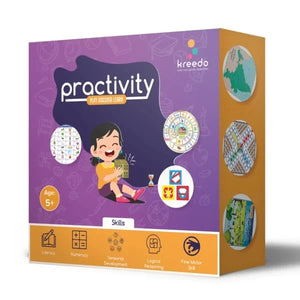
Flash Card Games for Kids: Beyond Rote Learning for School Readiness
Creative flash card games for kids are a powerful, research-backed method to enhance school readiness, moving beyond simple memorization to foster deeper cognitive skills. Child development experts confirm that interactive play significantly boosts a child's foundational learning abilities, making flash cards an invaluable tool for parents in India.
Many Indian parents feel the pressure of preparing their children for preschool, LKG, and UKG, often wondering how to make learning engaging rather than a chore. This post provides practical, fun, and Montessori-aligned ways to use flash cards to build essential skills, ensuring your child steps into school with confidence.
What are Creative Flash Card Games?
Creative flash card games transform passive memorization into active, multi-sensory experiences that captivate young minds. This matters because active engagement boosts memory retention, problem-solving, and critical thinking skills far more effectively than rote repetition. Indian parents can use these games to prepare children not just academically, but holistically for school.
Beyond Rote: Why Creative Flash Cards Matter for Indian Children
In India, where academic pressure can start early, it is vital to remember that true learning goes beyond memorizing facts. Research indicates that play-based learning improves cognitive flexibility and problem-solving skills by up to 30% compared to traditional methods. Flash cards, when used creatively, shift the focus from 'what to remember' to 'how to think and discover.'
This approach aligns perfectly with the Montessori philosophy, which advocates for active, hands-on exploration. As parents observe children trying to swipe physical books, echoing the recent news about changing literacy habits, incorporating tactile, interactive experiences like creative flash card games becomes even more critical to foster genuine engagement with learning materials.
Building Foundational Skills with Montessori Flash Cards
Montessori flash cards are meticulously designed to isolate concepts and encourage independent discovery, making them ideal for `school readiness activities`. Maria Montessori emphasized learning through senses, and flash cards can be an extension of sensorial exploration. For instance, pairing animal flash cards with corresponding figurines or sounds enhances sensory input.
These materials support the development of crucial skills such as observation, classification, and sequencing. They prepare the child's mind for more complex academic tasks by building a strong conceptual foundation. Explore our Montessori language materials to see how foundational concepts are introduced.
Interactive Flash Card Games for Language and Literacy
Language development is paramount for school readiness. Flash cards can be a playful gateway to vocabulary, phonics, and early reading. Here are some engaging `flash card games` for budding linguists:
- Storytelling Circles: Lay out a series of picture flash cards (animals, objects, actions). Ask your child, dadi, or nani to pick a card and start a story. Each person adds to the story by picking another card, fostering imagination and sequential thinking.
- "I Spy" with a Twist: Instead of colors, use initial sounds or categories. "I spy with my little eye something that starts with 'B'" (showing a 'Ball' flash card). This builds phonological awareness.
- Word-Picture Match: For older preschoolers, create simple word flash cards to match with picture flash cards. This strengthens sight word recognition and reading readiness. This kind of accessible learning, relevant across diverse settings, echoes discussions around early childhood education in rural India, proving that simple tools can be incredibly powerful.
Developing Numeracy with Engaging Flash Card Activities
Introducing numbers and quantities should be a joyful experience, not a daunting one. `Montessori flash cards` are excellent for developing number sense and basic mathematical understanding. Here's how to make numbers fun:
- Quantity Counting: Pair number flash cards with corresponding physical objects (e.g., a '3' card with three pebbles or beads). This helps visualize abstract numerical concepts.
- Number Sequence Race: Mix up number flash cards and ask your child to arrange them in order, either forwards or backwards. Time them for a friendly challenge, encouraging quick recognition.
- Simple Sums & Subtraction: Use flash cards depicting quantities or numerals for basic addition and subtraction. "If we have two mangoes (card 2) and get one more (card 1), how many do we have?" This builds early mathematical reasoning. Our Montessori math aids complement these activities perfectly.
Social-Emotional Growth Through Play-Based Flash Cards
School readiness extends beyond academics; social-emotional skills are equally crucial. `Play-based learning` with flash cards can help children understand emotions, practice turn-taking, and develop empathy. Sanskriti Global Pre-School emphasizes fostering unique potential, and these games support that holistic growth.
- Emotion Charades: Use flash cards depicting different emotions (happy, sad, angry, surprised). Children pick a card and act out the emotion, while others guess. This builds emotional vocabulary and recognition.
- "What Happens Next?" Social Stories: Create or use flash cards showing simple social scenarios (e.g., sharing a toy, waiting for a turn, helping a friend). Discuss with your child what might happen next or how to respond appropriately, preparing them for peer interactions in school. Studies show that children engaged in interactive early learning activities before age 5 have a significant advantage in literacy and numeracy upon entering primary school, alongside better social adjustment.
Key Takeaways for Parents
- Creative flash card games are a proven method to enhance school readiness, moving beyond rote memorization.
- Montessori principles encourage active, hands-on engagement with flash cards for deeper understanding.
- Flash cards can effectively develop language, literacy, and numeracy skills through interactive play.
- Using flash cards helps children build crucial social-emotional skills like empathy and turn-taking.
- Short, frequent, and playful flash card sessions are more effective for young children than long, repetitive ones.
- Integrating flash cards with physical objects and storytelling boosts sensory engagement and imagination.
By transforming simple flash cards into engaging activities, you are not just preparing your child for LKG or UKG; you are nurturing a lifelong love for learning. SkilloToys.com is committed to providing Montessori-inspired materials that empower Indian parents to make every learning moment count. Embrace these creative `interactive learning games` and watch your child flourish with confidence and joy.
At what age can children start using flash cards effectively?
Children can begin engaging with flash cards as early as 18-24 months for simple identification, progressing to more complex games by ages 3-5 for preschool and LKG readiness. The key is to introduce them playfully, following the child's interest and developmental stage.
How long should a flash card game session last for preschoolers?
Flash card game sessions for preschoolers should ideally last between 5-15 minutes, depending on the child's attention span and interest. Short, frequent sessions are more effective than long, drawn-out ones, ensuring the child remains engaged and enjoys the learning process.
Can flash cards be used for emotional development?
Yes, flash cards are excellent tools for emotional development, particularly when depicting different emotions or social scenarios. Using them in role-playing games helps children identify feelings, understand social cues, and develop empathy, crucial for navigating school environments.
What types of flash cards are best for preschoolers preparing for school?
For preschoolers, picture-based flash cards depicting everyday objects, animals, letters, numbers, and basic shapes are most effective. Montessori-aligned flash cards that are visually clear and isolate concepts help children focus and build foundational knowledge without clutter.
How do Montessori flash cards differ from traditional ones?
Montessori flash cards are designed to support independent, self-directed learning, often featuring real-life images, clear isolation of concepts, and control of error. Unlike traditional flash cards focused on rote memorization, Montessori cards encourage exploration, classification, and deeper understanding through hands-on activities.