Buzzing into Knowledge: Exploring the World with Montessori Nomenclature Cards
Ever noticed how children are naturally curious about everything around them, even the smallest creatures? From the wiggling worm to the buzzing bee, their little minds are constantly observing and questioning. Harnessing this innate wonder is key to fostering a lifelong love for learning.
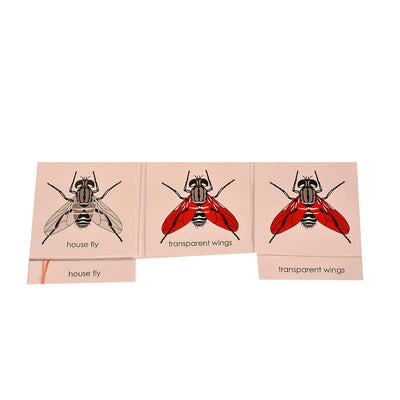
Today, we're diving into a fascinating educational tool that turns observation into a structured learning experience: the Montessori Nomenclature Learning Cards - Housefly. These aren't just flashcards; they're a gateway to scientific exploration and robust vocabulary building for children aged 3 to 10 years.
Why Learning About Nature (Even Insects!) Matters for Young Minds
Introducing children to the natural world, including insects, does more than just teach them facts. It cultivates observation skills, encourages respect for living things, and lays the groundwork for scientific thinking. Understanding the anatomy of even a common housefly helps children grasp concepts of structure and function in a tangible way.
What Makes Montessori Nomenclature Cards Special?
The Montessori method emphasizes hands-on, self-directed learning. Nomenclature cards are a prime example. This set for the housefly consists of three types of cards: picture cards with names, name-only cards, and picture-only cards. This unique format allows children to identify, name, and associate parts independently. Each part is often isolated in color, drawing the child's attention directly to what they are learning without overwhelming them with unnecessary details.
What Skills Do These Housefly Cards Develop?
These Montessori learning toys are packed with developmental benefits, making them excellent educational wooden toys (MDF board for durability) for early development skills in India.
Language and Vocabulary Enrichment
Children learn specific scientific terms for the parts of a housefly, like 'head,' 'thorax,' 'abdomen,' 'antennae,' and 'wings.' This expands their vocabulary far beyond everyday words, giving them a foundation in biological terminology. It’s fantastic for early readers and helps build confidence in language expression.
Observation and Concentration Skills
Matching the picture-only cards to the name-only cards, or comparing them with the complete picture-and-name cards, sharpens a child's visual discrimination. They learn to pay close attention to details, a crucial skill for both academic success and everyday life. This focused activity also improves their concentration span.
Cognitive Skills and Classification
The process of breaking down an object into its individual parts and then reassembling that knowledge fosters analytical thinking. Children learn to categorize and understand hierarchical relationships, which are foundational cognitive skills for problem-solving.
Early Introduction to Science and Biology
Without even realizing it, kids are introduced to basic biology and zoology concepts. They begin to understand that living things have distinct parts that serve specific functions. This playful introduction to scientific classification can spark a lifelong interest in STEM fields.
How Can Parents Use These Learning Cards at Home?
Parents searching for the best toys for toddlers and preschoolers will find these cards incredibly versatile for home learning activities.
The Classic Three-Part Lesson
Introduce the cards using the Montessori three-part lesson. First, name the part while pointing to it on the picture card. Second, ask your child to show you the named part. Third, ask your child, "What is this?" while pointing to a part. This method reinforces learning step-by-step.
Matching Games and Independent Exploration
Lay out the picture-only cards and ask your child to match the name-only cards to them. For older children, you can lay out the picture-and-name cards, then hide the name-only cards and ask them to recall and write the names, checking their answers afterward.
Nature Walks and Real-World Connection
After learning the parts, take a nature walk! If you spot a housefly (or even a drawing of one), encourage your child to identify its parts. This connects the abstract learning from the cards to real-world observation, making the knowledge truly stick.
These nomenclature flashcards offer a unique and effective way to teach complex concepts simply and engagingly. They are perfect for enriching your child's learning journey, fostering curiosity, and building a strong foundation in language and science.
Discover the power of hands-on learning with these engaging Montessori learning cards. SkilloToys is committed to bringing you high-quality educational toys that inspire curiosity and foster growth. Explore more such thoughtfully designed toys for your child's developmental milestones at SkilloToys.com.