Making Numbers Tangible: The Magic of Wooden Number Rods for Early Math
As parents, we often wonder how to make learning engaging and effective, especially when it comes to foundational concepts like mathematics. For many children in India, the first introduction to numbers can be a blend of rote memorisation and abstract symbols. But what if we could make numbers tangible, allowing children to truly grasp quantity with their own hands?
Enter the Wooden Number Rods – a classic Montessori learning tool designed to do exactly that. This simple yet profound educational wooden toy is a game-changer for early math skills, making the journey from counting to understanding quantity both intuitive and enjoyable for children aged 3 to 10 years.
What are Wooden Number Rods and How Do They Work?
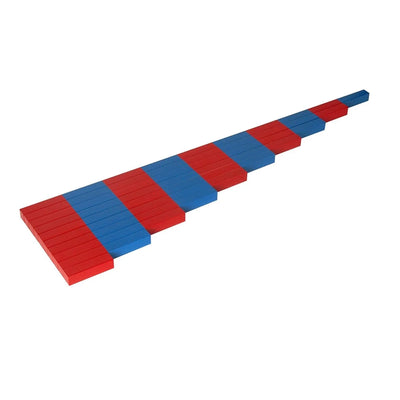
The Wooden Number Rods set consists of ten distinct wooden rods, each varying in length from 10 cm to a full meter. What makes them unique is their visual design: each rod is divided into units by alternating colours of red and blue. The shortest rod is one unit (10 cm), and the longest is ten units (1 meter).
This clever design allows children to physically see and feel the progression of quantity from 1 to 10. They can compare lengths, identify differences, and visually internalise what 'three' looks like compared to 'seven', for instance, before even writing the numeral.
What Skills Do Wooden Number Rods Develop in Children?
These Montessori learning toys are packed with benefits for your child's early development:
- Quantity and Number Recognition: Children connect the length of the rod to its numerical value, understanding quantities from 1 to 10 in a concrete way. This forms a strong foundation for abstract number concepts.
- Fine Motor Skills: Handling and arranging the rods helps in developing precision, coordination, and dexterity in small hand muscles.
- Visual Discrimination: Identifying differences in length and patterns strengthens their ability to differentiate and compare, a key pre-math skill.
- Sequencing and Ordering: Arranging the rods from shortest to longest (or vice versa) teaches logical sequencing and patterns.
- Early Math Concepts: Beyond simple counting, children naturally begin exploring concepts like addition (combining rods), subtraction (comparing differences), and spatial reasoning.
- Concentration and Problem-Solving: Engaging with the rods encourages focused attention and independent problem-solving as they try to order or match them correctly.
Why Choose Montessori Learning Toys for Early Development?
Montessori education is globally recognised for its child-centred approach, and toys like the Wooden Number Rods embody its core principles. These toys are designed to be self-correcting, allowing children to learn from their own discoveries rather than relying solely on adult correction.
They foster independence, critical thinking, and a deeper, more intuitive understanding of concepts. By engaging multiple senses – sight and touch – Montessori materials provide a rich, hands-on learning experience that sticks.
How Can Parents Use Wooden Number Rods at Home?
Using these best toys for toddlers and preschoolers is straightforward and fun! Start by introducing each rod by its length, counting the red and blue segments aloud. Ask your child to arrange them from shortest to longest, or vice versa.
You can then play matching games, asking them to find the rod that represents 'four' after counting it. As they grow, use the rods to introduce simple addition, for example, showing that the '2' rod and the '3' rod together equal the length of the '5' rod. The possibilities are endless for creative learning!
This high-quality Montessori toy is just one example of the thoughtfully curated collection at SkilloToys. We believe in providing educational wooden toys that inspire curiosity and foster crucial early development skills. Explore our range and find the perfect tools to spark a lifelong love for learning in your child. Visit SkilloToys.com today!