Doll House for Kids: Montessori Benefits (1-3 Years)
A high-quality doll house for kids is far more than just a toy; it is a foundational Montessori tool that profoundly supports holistic toddler development from 1 to 3 years. Research shows that engaging with miniature worlds empowers young children to mimic, explore, and understand the adult world around them, nurturing crucial cognitive, social, and emotional skills.
What is a Montessori Dollhouse?
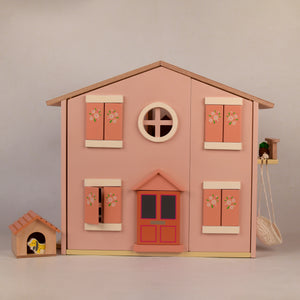
A Montessori dollhouse is a scaled-down, realistic representation of a home environment, designed to be open-ended and child-accessible. This matters because it allows toddlers to engage in self-directed imaginative play, processing observations of their daily lives. Indian parents can use this to help their child understand family dynamics and practical routines.
More Than Just Play: The Montessori Benefits of a Doll House for Kids
For toddlers between 18 months and 3 years, a doll house becomes a vibrant laboratory for life. Maria Montessori's philosophy emphasizes preparing the child for life, and a doll house provides a safe, controlled space for this. Imagine little Aarya, a two-year-old in a Bengaluru joint family, carefully arranging tiny furniture, mirroring how her Dadi meticulously sets up the living room for guests. This isn't just imitation; it's active learning.
These miniature environments help children develop critical practical life skills. As they manipulate small figures and furniture, they are refining their fine motor skills, enhancing hand-eye coordination, and building concentration. These are the same foundational skills needed for tasks like dressing themselves or pouring water, which are key aspects of Montessori education.
Cultivating Imaginative Play (1-3 Years)
The beauty of a well-designed montessori dollhouse lies in its simplicity and open-ended nature. Unlike electronic toys that dictate play, a doll house invites children to create their own narratives, making it ideal for imaginative play 1-3 years. They can re-enact daily routines like cooking a meal for the family, putting dolls to bed, or celebrating a festival with miniature decorations. This free-form play is essential for cognitive development, problem-solving, and emotional expression.
When a toddler engages in role-playing, they are processing their world, developing empathy, and practicing social scripts. They might pretend to be a parent, a grandparent, or even a friend, exploring different perspectives. This verbalisation and narration during play significantly boosts language development, helping them articulate feelings and understand complex social situations in a safe context.
Choosing the Best Dollhouse for Toddlers in India
When selecting a best dollhouse for toddlers, especially in an Indian context, consider materials, accessibility, and cultural relevance. Wooden doll houses are a fantastic choice for their durability, natural aesthetic, and tactile feel, aligning perfectly with Montessori principles of natural materials. Look for open designs that allow easy access from multiple sides, encouraging collaborative play even in smaller urban homes.
Child development experts recommend choosing doll houses with realistic details that reflect a child's environment, rather than overly fantastical elements. For instance, a doll house that can be arranged to represent an Indian home with spaces for a small mandir or a communal eating area can make the play more relatable and enriching for a child growing up in India. Such engagement reinforces their cultural identity while developing core skills. You can explore a range of high-quality, open-ended Montessori learning materials that foster this kind of immersive play.
Doll Houses as Essential Toddler Development Toys
The Union Minister Annpurna Devi's recent review of Women and Child Development Schemes in West Bengal, alongside initiatives like the BRICS Child Futures Forum, highlights the national focus on holistic child development. In this context, effective toddler development toys like doll houses are more crucial than ever. They are not merely for entertainment but serve as vital tools for achieving developmental milestones.
Beyond fine motor skills and imagination, doll houses help toddlers develop spatial reasoning. Arranging furniture, placing figures in different rooms, and understanding "inside" versus "outside" are all exercises in spatial intelligence. This lays crucial groundwork for future mathematical and scientific understanding. Studies indicate that children who engage in structured imaginative play show better narrative comprehension and executive function skills.
One non-obvious insight often missed is that the very "simplicity" of a Montessori-style doll house — with its less detailed, more abstract figures and furniture — actually demands more imagination from the child. It doesn't tell them a story; it gives them the tools to write their own. This active creation strengthens cognitive pathways far more than passively observing a pre-programmed toy.
Encourage your toddler to populate their doll house with figures that represent their own family – grandparents, parents, and siblings – to help them process social interactions and emotional experiences. This is a practical step parents can take tonight: observe your child's doll house play, and you'll gain invaluable insights into their inner world and understanding of family life.