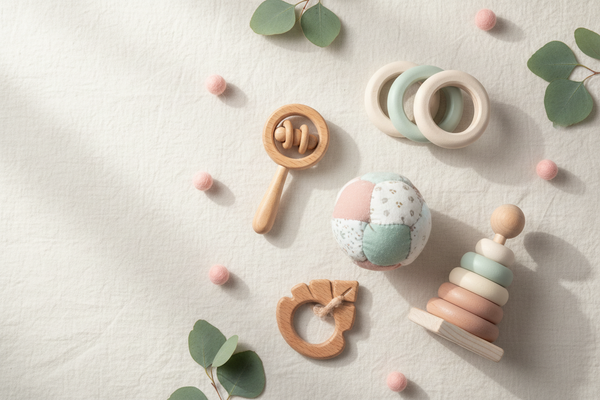
Educational Toys for Parents & Kids: Learning Together in India
The recent news from Saint Kabir Public School Karnal, where parents were invited to sit for exams alongside their children, highlights a significant shift in India's educational landscape: the growing emphasis on joint learning. This evolving dynamic underscores the vital role of educational toys for parents and kids to learn together, providing a definitive pathway for collaborative play and study that strengthens family bonds. Research indicates that active parental involvement through shared learning significantly boosts a child's academic success and emotional well-being.
What is Collaborative Learning with Educational Toys?
Collaborative learning with educational toys is an intentional approach where parents and children engage with learning materials side-by-side, sharing discoveries and solving problems together. This method matters because it shifts the focus from rote memorisation to active participation and mutual respect, building confidence and critical thinking. Indian parents can integrate these toys into daily routines, transforming study time into joyful, shared exploration.
Why Collaborative Learning Matters for Indian Families
In India, where academic pressure can be intense and the concept of parental involvement often leans towards supervision, the idea of 'joint learning' offers a refreshing perspective. Recent discussions, from the Bombay High Court's stance on 'joint parenting' to a Gurgaon CEO's reflections on Indian parenting norms, show a societal shift towards understanding the nuanced role parents play. Collaborative play with educational toys provides a healthier, more balanced approach to parental involvement in education toys, moving beyond just homework checks.
Strengthening Bonds and Reducing Exam Stress
Child development experts agree that shared experiences, particularly play, are fundamental to building strong parent-child relationships. When a parent and child work together on a puzzle or a building challenge, they're not just learning about shapes or gravity; they're learning to communicate, to take turns, and to celebrate small victories together. This shared effort creates a powerful emotional connection.
Furthermore, this approach offers a vital tool for toys to reduce exam stress India. Instead of looming deadlines and rigid study schedules, collaborative play infuses learning with joy and curiosity. For a 7-year-old in Bengaluru struggling with maths, a fun board game that involves counting and strategy, played with a parent, can make numbers less intimidating and more engaging. This positive association reduces anxiety, making children more receptive to learning.
Choosing the Right Educational Toys for Joint Study
Selecting the right tools is key to successful collaborative learning. The best toys are open-ended, allowing for multiple ways to play and learn, and engaging for both children and adults. Look for parent-child learning games India that encourage interaction, discussion, and shared discovery.
Montessori Principles for Joint Study
Montessori toys, based on the philosophy of Maria Montessori, are exceptionally well-suited for joint study. They are designed to be self-correcting, allowing children to learn from their mistakes independently, while parents can guide without directly providing answers. Imagine a 4-year-old Anya and her grandmother in Chennai working on a Geometric Solids set. The grandmother can introduce the names of the shapes, but Anya discovers how they stack or roll through her own experimentation.
Materials like the Pink Tower or Sandpaper Letters aren't just for individual learning. They become tools for Montessori toys for joint study, where parents can observe, ask open-ended questions like "What do you notice?" or "What happens if you try this?" and participate in the child's 'aha!' moments. This approach fosters a love for learning and critical thinking, moving beyond rote memorisation.
Interactive Games for Every Age
From toddlers to pre-teens, there are numerous options for collaborative learning toys for families. For the 18-24 month age group, simple stacking rings or shape sorters offer opportunities for parents to name colours and shapes. For 3-year-olds like Rohan in a joint family in Pune, activity kits focusing on art or science allow siblings and parents to create and explore together. Older children (6+ years) can engage in strategy board games that require teamwork, logic, and negotiation, teaching valuable social skills alongside academic concepts.
Practical Tips for Parents: Making Joint Learning Fun
The goal is to create an environment where learning feels like an adventure, not a chore. This requires a shift in mindset and some practical strategies that can be easily implemented in any Indian household.
Setting the Stage for Shared Discovery
Dedicate a specific time, even if it's just 20-30 minutes, when everyone can focus without distractions. Turn off screens, clear a space, and present the educational toy as an exciting new challenge to conquer together. For instance, when introducing a new puzzle, you might say, "Let's see if we can solve this mystery together!" rather than "Time to do your puzzle."
From Playtime to Learning Moments
The beauty of educational toys is their versatility. A set of building blocks can teach geometry and spatial reasoning, but also storytelling and imaginative play. When building a fort with your child, ask them about its inhabitants, what their routine is, or what challenges they might face. This expands the learning beyond just construction to language and creative thinking.
Navigating Challenges: Different Learning Styles
Every child, and indeed every parent, has a unique learning style. Some children are visual learners, others auditory, and many are kinesthetic (learning by doing). Observe how your child interacts with the toys. If they prefer to touch and manipulate, lean into hands-on wooden toys. If they enjoy listening, incorporate storytelling. The key is flexibility and adapting the play to suit everyone involved, making the experience positive and inclusive for all family members.
Embracing educational toys for parents and kids to learn together is more than just a trend; it's a powerful way to redefine family learning in India. By shifting focus from performance to process, from instruction to shared discovery, families can build stronger bonds, reduce academic pressure, and instill a lifelong passion for knowledge. SkilloToys.com offers a curated selection of Montessori-inspired and educational toys designed to facilitate these invaluable joint learning experiences. Explore our collections today and start your family's collaborative learning adventure.