Montessori Toys for Holistic Child Development in India
In India, many parents are consciously seeking ways to raise children who thrive beyond the relentless academic 'rat race,' prioritizing joy and genuine growth. Montessori toys for holistic child development India provide a proven framework for this approach, empowering children to cultivate creativity, individuality, and intrinsic motivation. This philosophy directly addresses a sentiment highlighted by recent news, where Indian families are opting for alternative parenting paths to nurture well-rounded individuals.
What is Holistic Child Development?
Holistic child development refers to nurturing every aspect of a child's being: cognitive, emotional, social, and physical, alongside their intellectual growth. This matters because a child who is balanced across these areas develops resilience, empathy, and a lifelong love for learning, rather than simply memorizing facts. Indian parents can actively support this by providing environments and tools that encourage self-directed exploration and growth in all these dimensions.
Beyond the Rat Race: A New Vision for Indian Childhood
The story of a Kolkata couple choosing to raise their children 'beyond the rat race' resonates deeply with many Indian parents today. The pressure to excel academically, secure top ranks, and navigate competitive school admissions can overshadow a child's natural curiosity and joy in learning. Child development experts consistently highlight that a singular focus on academic achievement can stifle creativity and critical thinking.
Instead of the 'grin and bear it' mantra often passed down through generations, conscious parenting seeks to cultivate an environment where making mistakes is seen as a crucial step in learning, as recently discussed in The Times of India. This shift helps children build resilience and confidence, understanding that progress comes from experimentation, not just perfection.
Fostering Creativity and Individuality through Play
To truly foster creativity and individuality in Indian kids, we must provide toys that invite imagination, not dictate it. Research indicates that children engaged with simple, open-ended materials develop stronger problem-solving skills than those exposed primarily to highly structured or electronic toys that do the 'imagining' for them. Maria Montessori herself emphasized the importance of a 'prepared environment' rich with materials that stimulate the child's inner drive to learn.
Consider the humble wooden blocks. A child can build a tall tower, a sprawling city, or a cozy home for their dolls, using their own ideas without external instructions. Similarly, activity kits that encourage art, craft, and constructive play empower a child to express themselves uniquely. These types of educational toys beyond rat race India promote intrinsic creativity, allowing children to explore their own unique solutions.
Building Non-Competitive Learning Skills
Montessori education inherently champions non-competitive learning, a stark contrast to the prevalent emphasis on comparisons and ranks in many Indian schools. At the heart of Montessori is the concept of self-correction, where materials are designed so a child can identify and rectify their own errors. For example, a 4-year-old like Ananya in a Bengaluru apartment, working with a knobbed cylinder puzzle, will know if a cylinder doesn't fit – no adult intervention or judgment is needed.
This process builds profound concentration and a sense of accomplishment, fostering an intrinsic motivation to learn rather than an external drive for approval. By engaging with authentic Montessori materials, children develop a deep understanding of concepts through hands-on experience, laying a solid foundation for future learning that goes far beyond rote memorization. They learn to love the process of discovery, a crucial skill for navigating life's complexities.
Supporting Emotional & Social Growth with Conscious Choices
Choosing educational toys for conscious parenting India extends to nurturing a child's emotional and social intelligence. Toys that encourage focused, independent play help children develop self-regulation and concentration, which are vital for emotional well-being. Simple puzzles or sensory bins for toddlers in the 1-3 years age group allow for calm, focused engagement.
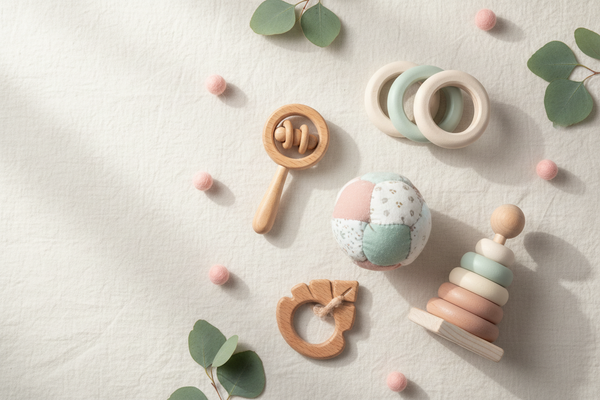
In a joint family, observing a younger child like Rishi (18 months) meticulously placing rings on a stacker, without interruption from his dadi, reinforces his autonomy. For older children in the 3+ years age group, practical life activities like preparing snacks or setting the table with child-sized tools build competence and a sense of contribution to the family. These experiences, rooted in real-life skills, cultivate confidence and respect for their environment and the people within it.
Choosing toys that support holistic development means looking beyond fleeting trends and towards materials that genuinely engage a child's mind, body, and spirit. Tonight, observe your child during their playtime. Do their toys invite curiosity and self-direction, or do they merely entertain? That observation is your first step towards fostering a childhood rich in discovery and individuality.