Children Absorb Language Fastest Before Age 3: The Montessori Way
Imagine your little one, barely a year old, pointing at a dog and confidently saying "bow-wow"! It’s moments like these that make us marvel at the incredible capacity of young minds. Did you know children absorb language fastest before age 3? This isn't just a fascinating fact; it's a cornerstone of early childhood development, profoundly observed and understood by Dr. Maria Montessori. This period, often called the 'absorbent mind,' is when children soak up everything around them, especially language, with an ease we adults can only dream of.
The Absorbent Mind, as defined by Dr. Maria Montessori, is a unique mental state present in children from birth to six years. This works because children in this phase have an unconscious, sponge-like ability to absorb knowledge and experiences directly from their environment without conscious effort. Parents can harness this innate capacity by creating a rich, stimulating, and supportive language environment at home.
The Miracle Years: Why 0-3 is Crucial for Language
During their first three years, a child’s brain is like fertile soil, ready to sprout a vast forest of words. This is when the foundational neural pathways for language are rapidly forming. Every sound, every word spoken in their presence, every interaction contributes to building their linguistic framework. From the babbling sounds of "ma-ma" and "da-da" to understanding complex sentences, the progression is astounding.
In many Indian homes, where often multiple generations live together, children are naturally exposed to a rich tapestry of languages. Grandparents conversing in their mother tongue, parents speaking English or Hindi, and household help chatting in regional dialects – all these sounds are a linguistic feast for a young child's absorbent mind. This exposure during the critical 0-3 age window helps build a robust linguistic foundation.
Crafting a Language-Rich Environment at Home
Creating a stimulating environment doesn't require elaborate setups; it's about intentional interactions and thoughtful choices. For Indian parents exploring Montessori at home India, this means being present and engaging with your child in their language journey. Simple daily activities become powerful educational toys for toddlers for language acquisition.
Speaking and Listening: The Foundation
Engage in direct, meaningful conversations with your child from day one. Talk to them as you would to an adult, using clear and articulate language, avoiding baby talk. Describe what you're doing, narrate your day, and respond enthusiastically to their babbling and attempts at communication. This constant exposure to correct speech patterns is vital for their language acquisition.
Encourage your child to express themselves, even if it’s through gestures or sounds initially. Give them ample time to respond, showing patience and respect for their developing voice. Whether it’s recounting stories of Indian festivals or simply naming the ingredients while cooking, these daily interactions lay a strong foundation for their verbal skills.
Enriching Vocabulary Through Everyday Life
Your home is a treasure trove of learning opportunities. Name everything: the "lal mirch" in the spice box, the "nilgiri" colour of the curtain, the "garam chai" in your cup. Point out objects, describe their textures, colours, and functions. This constant naming helps children associate words with concrete objects and experiences, building a rich vocabulary naturally.
Reading aloud is another powerful tool. Choose age-appropriate picture books that depict familiar scenes from Indian life or simple stories. Even looking at pictures and describing them together, like identifying a "cow" or a "temple," fosters language growth. Engaging with high-quality educational toys for toddlers, such as animal figurines or simple puzzles, also provides context for new words.
Montessori Language Materials for Young Children
While natural interaction is key, specific Montessori language materials are designed to enhance and refine a child's linguistic understanding. These materials isolate concepts and provide a hands-on approach to learning sounds, letters, and words, making them perfect for Montessori learning activities at home.
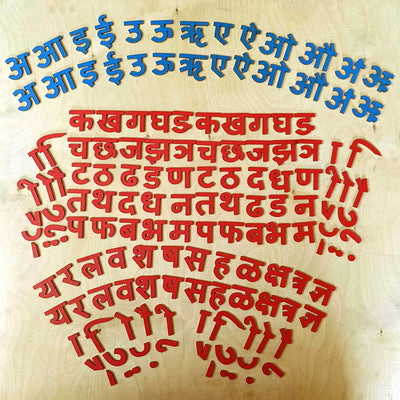
For the 0-3 age group, sensorial experiences are paramount. Things like Sandpaper Letters introduce the sound (phonetic awareness) and the shape of letters through touch. Picture cards with nomenclature labels help build vocabulary, associating images with written words. The Movable Alphabet, while typically introduced later, can be a fascinating tool for younger children to explore letter shapes and simple word building, fostering early literacy skills.
At SkilloToys.com, you can explore a range of carefully curated Montessori language materials designed to support your child's journey from sounds to fluent speech. These resources are designed to be engaging, child-led, and developmentally appropriate, perfect for curious young minds.
Beyond Materials: The Role of the Prepared Adult
Dr. Montessori emphasised the "prepared adult" – a parent or caregiver who observes the child, understands their developmental needs, and provides appropriate support without interference. For language development, this means listening patiently, correcting gently (if at all, by rephrasing correctly rather than direct correction), and being a rich source of correct language.
Be responsive to your child’s attempts at communication, even if they are incomplete. Expand on their single words, turning them into full sentences. For example, if your child says "pani," you can respond, "Yes, you would like some cold water." This consistent modelling of complete thoughts and sentences is crucial for their developing linguistic abilities and reinforces the power of their Montessori method learning materials toys use.
Key Takeaways
- Children possess an 'absorbent mind' from 0-6 years, with the period before age 3 being critical for rapid language acquisition.
- Expose children to rich and varied language in their environment, including multiple languages common in Indian homes.
- Engage in direct, clear conversations with your child, narrating daily activities and avoiding baby talk.
- Enrich vocabulary by naming objects, describing experiences, and reading aloud regularly.
- Utilise Montessori language materials like Sandpaper Letters and nomenclature cards to support phonetic awareness and vocabulary building.
- The prepared adult plays a vital role by observing, responding patiently, and providing a model of correct language.
Frequently Asked Questions about Early Language Development
Why is early language development so crucial?
Early language development is crucial because it forms the foundation for all future learning, including reading, writing, and critical thinking. It also deeply impacts a child's social-emotional skills, allowing them to express needs, understand others, and build relationships.
How can I encourage my child to speak more?
To encourage your child to speak more, engage in frequent conversations, read aloud daily, sing songs, and give them opportunities to express themselves without interruption. Expand on their one-word answers into full sentences to model complete thoughts.
Are multilingual homes confusing for toddlers?
No, multilingual homes are generally not confusing for toddlers. Young children are remarkably adept at distinguishing between languages, especially when exposed consistently. In fact, being raised multilingual can offer cognitive benefits, such as enhanced problem-solving skills and cultural understanding.
What specific Montessori materials help with language?
Specific Montessori materials that aid language development include Sandpaper Letters for phonetic sounds, Nomenclature Cards for vocabulary and classification, and the Movable Alphabet for early word building and spelling. These hands-on tools provide a concrete way to explore abstract language concepts.
The first three years are a truly extraordinary time for your child's language journey. By understanding their incredible capacity to absorb, and by providing a loving, language-rich environment, you empower them with a lifelong gift. Explore thoughtfully designed Montessori resources at SkilloToys.com to support every step of this wonderful adventure.