Teaching Maths at Home with Montessori Number Rods
As Indian parents, we often seek engaging ways to nurture our child's development right within our homes. The idea of introducing abstract concepts like mathematics can feel daunting, especially for toddlers and preschoolers. But what if learning numbers could be as natural and joyful as playing with building blocks? This is where Montessori number rods come into their own, transforming early maths education into a tactile and intuitive experience for your little one.
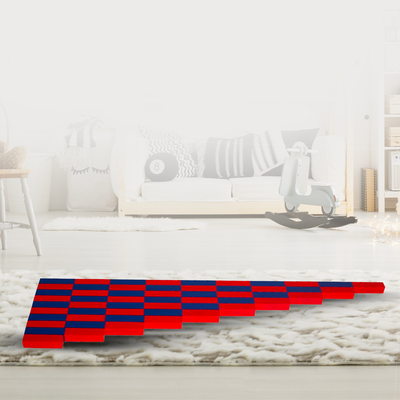
Montessori number rods are a foundational mathematics material designed by Dr. Maria Montessori to help children understand quantities from 1 to 10. Each rod is divided into alternating red and blue segments, with the shortest rod being 10 cm (one segment) and the longest being 100 cm (ten segments). This works because children can physically hold, compare, and count the segments, allowing them to grasp the concept of quantity before they even learn to write the numerals. Parents can easily introduce these rods as a concrete representation of numbers, building a strong foundation for abstract mathematical thinking.
The Magic of Hands-On Learning
In a typical Indian household, space might be a premium, but the desire for quality education is always vast. The beauty of Montessori materials like the number rods is that they don't require an entire classroom; a quiet corner or even the living room floor is enough. They allow children to learn through discovery, engaging their senses and fostering a deep understanding rather than rote memorisation.
Introducing Quantities, Not Just Numbers
One of the core principles of Montessori education is to move from the concrete to the abstract. Instead of simply telling a child that this is 'one' or 'two', the number rods allow them to see, touch, and feel the difference in quantity. For instance, holding the 'one' rod and then the 'two' rod clearly demonstrates that 'two' is one more than 'one'. This visual and tactile comparison is crucial for developing a robust number sense.
Building Number Sense from 1 to 10
To begin, invite your child to lay out the rods in order from shortest to longest. You can say, "Let's make a staircase!" Point to the shortest rod and say, "This is one." Then point to the next rod and count its segments, "One, two. This is two." Continue this process, pairing the quantity with its name. Later, you can introduce a separate set of number cards (1-10) and ask your child to match the numeral to the corresponding rod. This activity forms a crucial part of early Montessori mathematics materials and helps solidify the connection between quantity and symbol.
Montessori at Home: Tips for Indian Parents
Integrating Montessori learning activities into the rhythm of an Indian home offers unique opportunities. Whether you live in a bustling joint family or a cozy apartment, there are ways to make this work beautifully for your child's development in India.
Integrating Learning into Daily Life
The lessons learned with number rods can extend into everyday scenarios. When preparing for Diwali, count diyas with your child. During family gatherings, count the number of cousins or grandparents present. This natural reinforcement helps your child see maths as a part of their world, not just a classroom exercise. Such Montessori method learning materials toys are designed to connect with real-world experiences.
The Role of Grandparents and Family
In many Indian homes, grandparents play a vital role in child-rearing. Encourage them to engage with the number rods too! Their patient guidance and storytelling can add another layer of cultural richness to the learning process. Simple counting games during family time can significantly boost a child's understanding and enjoyment of numbers, fostering strong bonds alongside educational toys for toddlers.
Beyond the Rods: Expanding Maths Exploration
Once your child is comfortable with the number rods, you can introduce other related concepts. For instance, using small objects like beads or buttons, they can create their own 'number lines' corresponding to the rods. Incorporate other tactile materials like natural elements or even some wooden toys to count and sort, extending their understanding of quantity and classification. This holistic approach ensures continuous child development in India.
Key Takeaways
- Montessori number rods provide a concrete, hands-on way for children to understand numbers 1-10.
- They help build strong number sense by linking quantity with numerical representation.
- The rods encourage self-correction and independent learning through their design.
- Integration into daily Indian home life, with family involvement, enhances learning.
- This foundational material prepares children for more complex mathematical concepts.
Frequently Asked Questions About Montessori Number Rods
What age are Montessori number rods suitable for?
Montessori number rods are typically introduced to children aged 3 to 5 years. At this age, children are naturally curious about quantities and are ready for hands-on exploration of basic mathematical concepts.
Can I make my own number rods at home?
While DIY versions can be a good starting point, authentic Montessori number rods are precisely measured and weighted for specific learning outcomes. The exact dimensions and colours are crucial for the material to function as intended in teaching number sense and linear measurement.
How do number rods prepare children for higher maths?
Number rods lay the groundwork by establishing a concrete understanding of quantity, sequence, and addition. This sensory experience helps children internalise mathematical relationships, making the transition to abstract concepts like algebra much smoother later on.
Where can I find quality Montessori materials in India?
For authentic and durable Montessori learning materials designed to withstand repeated use, you can explore reputable stores like SkilloToys.com. They offer a range of educational toys and materials crafted to support your child's development at home.
Introducing maths through Montessori number rods is more than just teaching numbers; it's about fostering a love for learning and discovery. It empowers your child to explore the world of mathematics with confidence and joy, right from your home. SkilloToys.com is dedicated to providing high-quality, authentic Montessori materials to support your homeschooling journey.