Doll House for Kids: Outdoor Movement Journeys
Integrating a doll house for kids into outdoor gross motor obstacle courses definitively transforms playtime, fostering robust physical development, imaginative engagement, and a crucial connection with nature for Indian children. This innovative approach combats sedentary lifestyles, promoting essential movement skills and cognitive growth through purposeful play.
This method provides a unique solution for parents eager to get their children moving outdoors, especially relevant in today's context where screen time often replaces sunshine, leading to concerns about vitamin D deficiency and myopia in Indian children.
What is a Montessori Movement Journey with Dollhouses?
A Montessori Movement Journey integrating dollhouses is a structured outdoor obstacle course where a doll house for kids acts as a central station for imaginative play and gross motor challenges. This matters because it combines purposeful movement with creative storytelling, enhancing physical agility, problem-solving, and social skills. Indian parents can easily set up these engaging courses in their gardens or balconies.
The Critical Need for Outdoor Movement in Indian Children
Child development experts agree that consistent outdoor play is indispensable for holistic growth, yet urban Indian children often face diminishing opportunities for it. Recent reports, like those from India Today, highlight an alarming rise in vitamin D deficiency due to less sunshine exposure, while Healthcare Radius notes the alarming rise of myopia, strongly linked to reduced outdoor time.
For generations, Indian children thrived on outdoor games in gulmohar-shaded courtyards and bustling gullies. Today, with academic pressures, limited safe spaces, and the allure of digital screens, many children are missing out on the essential physical and sensory stimulation that nature provides. The Times of India underscores that outdoor play is as crucial as study time for a child's development.
Montessori Principles Guiding Outdoor Gross Motor Play
Maria Montessori herself advocated for purposeful movement and a deep connection with nature, recognising that physical activity is not separate from intellectual development but integral to it. Montessori outdoor play extends the prepared environment beyond the classroom walls, encouraging children to explore, experiment, and develop their capabilities through active engagement with their surroundings.
In a Montessori setting, movement is viewed as a key to learning. Gross motor skill development, through activities like climbing, balancing, and running, builds strength, coordination, and spatial awareness. These experiences lay foundational neural pathways crucial for later cognitive tasks, embodying the Montessori philosophy that the hand is the instrument of the mind.
Crafting Your Doll House Outdoor Obstacle Course: Kids Obstacle Course Ideas
Designing an engaging outdoor obstacle course around a doll house for kids transforms simple play into a dynamic learning adventure. Begin by placing the dollhouse as a central 'home base' or 'treasure chest' within your outdoor space, whether it's a spacious garden or a cozy balcony. The goal is for children to navigate various challenges to reach the dollhouse, interact with it, and then move on to the next task.
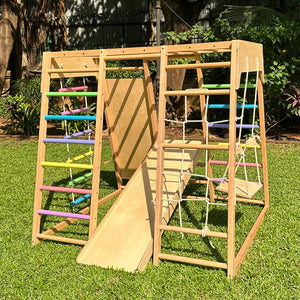
Consider incorporating elements that encourage a range of gross motor activities. For example, lay out stepping stones or cushions for balancing, create a 'river' using a blue sheet to jump over, or use hula hoops for crawling through. A simple tunnel can become a 'secret passage' leading to the dollhouse's front door. Encourage children to collect 'supplies' for the dollhouse (leaves, pebbles, flowers) along their journey, integrating nature exploration.
In joint family homes, grandparents often enjoy helping set up these courses, weaving in stories and traditional elements. Imagine a 'journey to Nani's house' where the dollhouse represents her home, requiring children to cross a 'bridge' (a plank) and 'climb a hill' (a small mound) to deliver their collected treasures. This fosters intergenerational bonding alongside physical development.
Benefits of This Unique Outdoor Gross Motor Activity
This innovative blend of a doll house for kids with outdoor gross motor activities offers a multitude of benefits for children's physical development games. Research indicates that complex motor skills developed through obstacle courses significantly enhance balance, coordination, agility, and muscular strength.
- Physical Development: Children strengthen core muscles, improve balance, and develop fine motor control as they manipulate dollhouse figures after navigating the course.
- Cognitive Skills: Planning their route, problem-solving through obstacles, and remembering sequences all boost executive functions and critical thinking.
- Imaginative Play: The dollhouse provides a rich narrative context, transforming a simple course into a story-driven adventure, fostering creativity and language development.
- Emotional Regulation: Successfully completing challenges builds confidence and resilience, while outdoor play naturally reduces stress and promotes a sense of well-being.
This integrated approach is particularly effective in engaging children who might otherwise be drawn to screens, offering a compelling and active alternative that fulfills their natural need for movement and exploration. For Indian children facing increasing sedentary lifestyles, these activities are vital for ensuring comprehensive physical development.
Tips for Indian Parents: Maximising Montessori Outdoor Play
Indian parents can easily adapt these Montessori outdoor play ideas to various home environments. If a large garden isn't available, utilise a spacious balcony or even a clean, open verandah. Simple household items like sarees for tunnels, pillows for jumping, and plastic buckets for collecting can be repurposed into exciting course elements.
Encourage children to be part of the setup process; this fosters a sense of ownership and planning skills. During festivals like Diwali or Holi, incorporate themed elements into the course, like collecting diyas or colourful powders for the dollhouse, making the play culturally relevant and even more engaging. Remember, the key is to allow freedom of movement within a prepared, safe environment. Montessori materials are designed for hands-on, purposeful engagement, and extending this philosophy outdoors amplifies its benefits.
- Integrating a doll house for kids into outdoor obstacle courses significantly enhances physical development through purposeful movement.
- Montessori principles advocate for consistent outdoor exploration, recognising its crucial role in holistic child development.
- Outdoor play directly combats prevalent health issues in Indian children, such as vitamin D deficiency and myopia, often linked to increased screen time.
- These engaging activities foster essential skills including imagination, problem-solving, balance, and coordination.
- Indian parents can easily adapt and implement these ideas in diverse home environments, from gardens to balconies, using readily available materials.
- Child development experts confirm that combining imaginative play with gross motor activities builds strong neural pathways and emotional resilience.
How does a doll house for kids boost gross motor skills?
A doll house for kids boosts gross motor skills by acting as a destination or focal point within an obstacle course, encouraging movement like crawling, climbing, balancing, and running to reach it. Children engage their large muscle groups as they navigate challenges to play with or retrieve items for their dollhouse characters.
What are common outdoor gross motor activities suitable for Indian homes?
Common outdoor gross motor activities for Indian homes include setting up simple obstacle courses in a garden or even a spacious balcony, using items like cushions for jumping, laundry baskets for crawling, or chalk lines for balancing. Traditional games like hopscotch and kho-kho also provide excellent gross motor engagement.
How can I encourage Montessori outdoor play with limited space?
Montessori outdoor play can be encouraged in limited spaces by focusing on purposeful activities like tending to small potted plants, water play with buckets, or creating mini sensory bins with natural elements. Even a small balcony can host an engaging 'nature shelf' or a scaled-down obstacle course for focused movement.
What age is best for introducing dollhouses into obstacle courses?
Introducing dollhouses into outdoor obstacle courses is best for children typically from 2.5 to 6 years old, as they develop both gross motor coordination and imaginative role-playing skills. Younger toddlers (18-24 months) can enjoy simpler versions focused on reaching and manipulating large dollhouse pieces.
How can outdoor play combat screen time and vitamin D deficiency?
Outdoor play directly combats excessive screen time by providing a compelling, engaging alternative that encourages physical activity and fresh air. Regular sun exposure during outdoor play is crucial for natural vitamin D synthesis, effectively addressing prevalent deficiencies among Indian children.