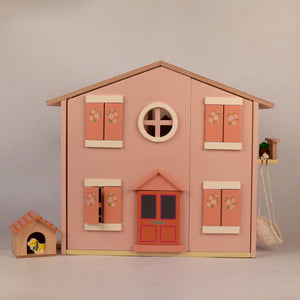
Doll House for Kids: Age-Specific Montessori Play (1-3 Years)
A doll house for kids is far more than just a toy; it is a foundational tool for early childhood development, directly answering the high-impression query about its value. Research shows that engaging with a doll house helps toddlers process their world, develop crucial social skills, and nurture imaginative thinking. Within a Montessori framework, this play evolves dynamically, supporting specific milestones for children from 1 to 3 years old.
What is Montessori Doll House Play?
Montessori doll house play involves a child-centered approach where the miniature home and its inhabitants serve as a 'prepared environment' for practical life activities and social exploration. This matters because it allows children to spontaneously engage with materials, developing independence and concentration. Indian parents can observe their child's interests and offer relevant, simple props to deepen this meaningful play.
Montessori Doll House Play for 1-Year-Olds: Sensory Exploration & First Connections
For a 1-year-old, the doll house is primarily a world of sensory exploration and cause-and-effect. They are drawn to large, chunky pieces they can grasp, move, and perhaps mouth safely. Think about a child like little Aanya in Bengaluru, who at 14 months, might focus on putting a small wooden doll into a bed or closing a tiny door repeatedly. This isn't just random action; it's a deep dive into object permanence and understanding basic spatial relationships.
At this age, the developmental benefits of a doll house include refining their pincer grasp and understanding simple actions like 'in' and 'out.' Your role is to offer minimal guidance, perhaps demonstrating one or two actions like placing a doll on a chair, then allowing them to explore freely. The satisfying thud of a wooden block or the texture of a fabric doll helps build early cognitive connections. Child development experts agree that such early, open-ended material interaction is vital for brain development. Explore our collection of Montessori learning materials and toys designed for tactile engagement.
Montessori Doll House Play for 2-Year-Olds: Language & Social Roles
As toddlers approach their second birthday, doll house activities become richer, fostering language and social understanding. Two-year-olds begin to mimic daily routines they observe at home, which is particularly vital in a bustling Indian joint family. A child might have their doll 'eat lunch' or 'talk to Dadi,' reflecting the interactions they see around them. This is where the doll house becomes a miniature stage for processing complex family dynamics and social roles.
Research from leading early childhood education frameworks, including those influenced by UNICEF and NCERT, consistently advocates for play that mirrors real life. A 2.5-year-old like Rohan from Chennai might use the doll house to reenact his parents leaving for work and coming back, saying simple phrases like "Bye-bye, Papa!" and "Hello, Mama!" This practice builds vocabulary, narrative skills, and helps them understand social sequences. Offer simple prompts like "What are they doing now?" or "Who is going to the kitchen?" to encourage language and narrative development.
Montessori Doll House Play for 3-Year-Olds: Complex Narratives & Emotional Intelligence
By age three, doll house play transforms into sophisticated storytelling and emotional processing. Children at this stage are capable of creating intricate scenarios, weaving together characters, plots, and even emotional conflicts. They might enact a festival celebration, a visit to grandparents, or resolve a "fight" between two doll figures. This is a critical period for developing empathy, problem-solving skills, and a deeper understanding of human emotions.
Maria Montessori's philosophy emphasizes that children learn by doing and by internalizing their environment. The simplicity of a Montessori doll house, often made from natural wood, encourages the child to provide the imagination, rather than being limited by highly detailed, prescriptive settings. This cognitive work strengthens their creative thinking and prepares them for the abstract thought required for early schooling. You might observe a 3.5-year-old, like Maya from Delhi, meticulously arranging a tea party for her doll family, assigning each figure a role and expressing their "feelings." This kind of play is a powerful precursor to abstract reasoning and social navigation.
Choosing the Right Montessori Doll House for Your Home
When selecting a Montessori doll house for your child, prioritize natural materials, open-ended design, and durability. Wooden doll houses are excellent as they are tactile and long-lasting, fitting well into the aesthetic of many Indian homes. Look for figures that are simple and representative, allowing children to project their own ideas and emotions onto them. The goal is to provide a "prepared environment" that invites exploration without overwhelming. Consider accessories that reflect everyday life in India, like tiny cooking pots, small fabric pieces for sarees or dhotis, or miniature traditional instruments, to make the play even more resonant.
Doll house play is not just about fun; it's a powerful developmental journey from a child's first explorations to their complex narratives. By understanding these age-specific Montessori principles, you can provide an enriching environment that supports your child's growth every step of the way, helping them to thrive emotionally, socially, and cognitively in their world.