Doll House for Kids: Nurturing Creativity & Life Skills
A doll house for kids serves as a vital miniature world where children, especially in India's screen-saturated environment, actively cultivate imagination and crucial developmental skills. Research shows that engaging with open-ended toys like doll houses is fundamental for fostering cognitive flexibility and emotional intelligence, counteracting the passive consumption often seen with digital media.
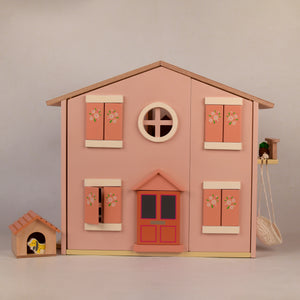
A doll house for kids is a scaled-down model of a home, typically featuring furniture and figures, designed to facilitate imaginative play. This matters because it provides a rich environment for children to mimic real-life scenarios, develop social understanding, and practice communication. Indian parents can use this classic toy to bridge traditional family values with modern developmental insights, creating a powerful learning tool.
The Stage for Imaginative Play: A Doll House for Kids
As the Deccan Chronicle recently highlighted, play still matters profoundly in a screen-filled childhood. A doll house for kids offers that essential space, providing a safe, accessible platform for limitless storytelling. Here, children become directors, scriptwriters, and performers, crafting intricate narratives that reflect their understanding of the world.
Imagine your little one, Riya from Bengaluru, meticulously arranging tiny furniture or enacting a Diwali celebration in her miniature home. This isn't just playing; it's a deep dive into creating characters, developing plots, and articulating dialogue, fostering language skills and abstract thinking far more effectively than any app could.
Beyond Play: Creative Development and Problem-Solving
The beauty of a doll house lies in its open-ended nature, which is a cornerstone of Montessori learning materials. When a child decides where the kitchen goes or how the family resolves a 'conflict' over a missing toy, they are actively engaging in problem-solving and spatial reasoning. They learn to plan, adapt, and think creatively within a self-constructed environment.
Studies by the American Academy of Pediatrics emphasize that unstructured, imaginative play is crucial for developing executive functions like planning, organization, and problem-solving in children aged 3-7 years. This is a vital period where the brain is actively building connections for future academic and life success, making the creative play doll house a powerful developmental tool.
Montessori Principles in Miniature: Benefits of a Montessori Doll House
Maria Montessori's philosophy champions hands-on learning and practical life skills, and a doll house aligns perfectly with this approach. A Montessori doll house, often crafted from natural wood and featuring realistic details, encourages children to mimic daily chores and responsibilities observed in their own homes, from cooking meals to tidying up.
Just as a child learns order and precision with a Montessori puzzle, they learn domestic order and care with a well-designed doll house. This focus on scaled-down reality helps children internalize concepts of home management, independence, and contributing to a household, preparing them for real-world scenarios in their Indian family settings.
Nurturing Empathy and Communication: Role-Playing Toys for Kids
Doll houses are quintessential role-playing toys for kids, offering a safe space to explore emotions and social dynamics. A child might take on the role of an elder sibling caring for a younger one, or a grandparent sharing stories, reflecting the rich tapestry of relationships in an Indian joint family.
Child development experts agree that role-playing is paramount for developing empathy and understanding social cues, a skill vital for navigating diverse family structures common in India. Children learn to articulate feelings, negotiate scenarios, and develop a deeper understanding of human behavior, all through the joyous medium of play within their miniature world.
Bringing Home the Magic of Imagination
In a rapidly digitizing world, where even news outlets like Indiagazette.com report on the growing demand for hands-on creativity initiatives, giving your child the gift of a doll house is more than just buying a toy. It's an investment in their holistic development, fostering skills that screens simply cannot replicate. It's about providing a concrete space for the abstract world of imagination to flourish.
As parents, we strive to raise resilient, empathetic, and innovative thinkers. By embracing the power of the doll house, you're not just offering entertainment; you're offering a foundation for lifelong learning and creativity. Tonight, watch your child interact with their doll house, and you'll witness the magic of their growing mind firsthand.