Doll House for Kids: Storytelling Boosts Imagination & Skills
A well-chosen doll house for kids provides far more than simple entertainment; research shows it becomes a dynamic stage where children cultivate crucial imaginative and social-emotional skills. This powerful play tool allows young minds to craft narratives, explore complex emotions, and develop vital social competencies, making it an indispensable part of early childhood development.
What is Doll House Storytelling? Doll house storytelling is when children use miniature figures and furniture within a doll house setting to create narratives and act out scenarios. This imaginative play is essential for processing observations, developing empathy, and practicing communication skills in a self-directed environment.
The Miniature World, The Grand Imagination
Doll houses serve as miniature canvases for a child's blossoming imagination, offering a tangible space for imaginative doll house play. Here, a child can be the director, writer, and cast, bringing stories to life that reflect their world and their wildest dreams. From preparing for a grand Diwali celebration with tiny diyas and family gatherings to navigating the everyday hustle of school drop-offs, the possibilities are limitless.
This kind of open-ended play is critical for cognitive development. Child development experts at the Harvard Center on the Developing Child emphasize that unstructured, imaginative play builds crucial executive function skills, including flexible thinking and self-regulation. For a 4-year-old like Rhea in Bengaluru, her wooden doll house might become a bustling apartment building, with characters mimicking her joint family members and neighbours, allowing her to process her daily observations.
Building Bridges of Empathy: Social-Emotional Learning Through Doll Play
Beyond imagination, doll house storytelling is a powerful social emotional learning toys activity. Children naturally use doll house scenarios to explore feelings, practice empathy, and understand different perspectives. They might act out a sibling argument, a visit from grandparents, or even a tricky situation from school, finding resolutions through their characters.
The American Academy of Pediatrics highlights that role-playing games are strongly linked to higher levels of empathy and emotional intelligence in children. Through their doll house residents, children can express fears, joys, and frustrations in a safe, controlled environment, learning to name and manage their emotions. Imagine little Rohan acting out his doll character helping another doll who is sad – this is direct practice in compassion and problem-solving.
Creative Play Ideas with Your Doll House for Kids
Encouraging diverse and creative play ideas dollhouse activities doesn't require elaborate setups. Simple additions can spark incredible stories. Encourage your child to use small pebbles as food, fabric scraps as blankets, or even craft tiny musical instruments from cardboard for a doll house concert.
You can also introduce scenarios related to Indian festivals or traditions. Perhaps the doll family is celebrating Eid, making rangoli for Diwali, or getting ready for a wedding. These culturally resonant activities deepen their understanding of their heritage while enhancing their narrative skills. SkilloToys' activity kits can inspire similar creative extensions for broader imaginative play.
Montessori Doll House Activities: Nurturing Self-Directed Play
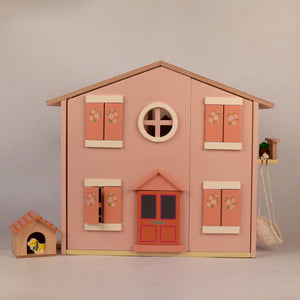
The Montessori approach strongly advocates for open-ended, child-led play, and a doll house for kids fits this philosophy perfectly. A Montessori doll house activities focus on realism and simplicity, allowing the child's imagination to do the heavy lifting rather than being dictated by complex, pre-designed elements. This encourages deeper engagement and problem-solving.
Maria Montessori herself believed that children learn best through direct experience and exploration. With a wooden, minimally furnished doll house, a child is empowered to design rooms, assign roles, and create stories entirely from their inner world. This self-directed play fosters independence, concentration, and an intrinsic love for learning that extends far beyond playtime, resonating with the ethos of excellence seen in institutions like Sunbeam World School.
Providing a doll house for kids isn't just about offering a toy; it's about giving them a miniature universe to explore, create, and grow. Encourage your child to dive into the world of doll house storytelling, and watch their imagination soar and their social-emotional intelligence blossom. It's a simple, yet profoundly impactful, gift for their holistic development.