Hindi Alphabets at Home: A Montessori Guide for Indian Parents
For Indian parents embracing homeschooling, the journey of teaching Hindi alphabets at home offers a unique opportunity to connect children with their linguistic heritage. This Montessori-inspired guide empowers you to introduce the beautiful Devanagari script in a way that is engaging, effective, and deeply respectful of your child’s natural learning pace.
Teaching Hindi alphabets at home involves guiding children through the phonetic sounds and visual forms of the Devanagari script. This matters because early language acquisition strengthens cognitive development, cultural connection, and prepares children for a diverse world. Indian parents can foster this learning through play-based, hands-on activities that ignite curiosity.
Why Montessori for Hindi Learning?
Child development experts agree that the Montessori method, with its emphasis on hands-on exploration and self-directed learning, is exceptionally effective for language acquisition. For Indian families, this approach aligns perfectly with the homeschooling trend, as highlighted by articles from News18 and The Better India discussing reduced exam pressure and personalized education.
Maria Montessori's philosophy promotes a 'prepared environment' where children can discover concepts independently. When teaching Hindi, this translates into making phonetic sounds and alphabet shapes accessible through tactile and visual means. This method respects the child's absorbent mind, allowing them to internalize language naturally rather than through rote memorization.
How to Teach Hindi at Home: Setting Up Your Learning Space
Creating a dedicated, inviting space for Hindi learning is crucial for success. This doesn't require a separate classroom; a quiet corner in the living room or a low shelf in your child's play area can suffice. Ensure materials are child-sized and easily accessible, inviting your little one to explore independently.
Consider placing a small mat or rug to define the 'work area' for Hindi activities, signaling to the child that this is a space for focused engagement. Research shows that a well-ordered environment reduces distraction and promotes concentration, a cornerstone of effective learning for young children.
Essential Hindi Alphabet Activities for Kids: Montessori Style
Montessori learning thrives on sensory experiences. Here are some effective activities:
1. Sandpaper Hindi Alphabets: The Tactile Start
Introduce Hindi letters using sandpaper alphabets. These tactile materials allow children to feel the shape of each letter, connecting the visual form with a physical sensation. Present one letter at a time, tracing it with your fingers while enunciating its phonetic sound clearly, rather than its name. For example, for 'क', say 'ka' not 'ka-ra'.
This concrete experience lays a strong neurological foundation for writing and reading. SkilloToys offers a range of Montessori learning materials, including similar concepts that can be adapted for Hindi, fostering early literacy skills.
2. The Moveable Alphabet: Building Words
Once your child has a grasp of individual sounds and shapes, introduce the moveable Hindi alphabet. These small, individual cut-out letters (or even handmade ones) allow children to form words phonetically, even before they can write. Start with two-letter words, then three-letter words familiar in an Indian household, like 'घर' (ghar - home) or 'जल' (jal - water).
This activity encourages exploration of word construction and develops early spelling skills. It's a wonderful way to foster independence in learning and reinforce the concept that letters combine to make meaningful words.
3. Matching & Pairing Games: Reinforcing Recognition
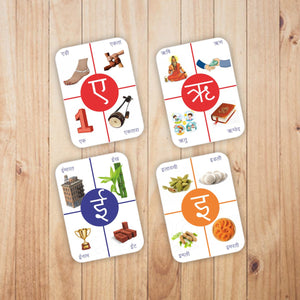
Create matching games using flashcards with Hindi letters and corresponding pictures of objects that start with that letter (e.g., 'आम' for 'आ', 'गाड़ी' for 'ग'). You can also pair identical letter cards. This visual discrimination practice is key for solidifying letter recognition.
Involve grandparents in creating these materials, perhaps using traditional stories or items from the kitchen garden. These interactive activity kits enhance memory and make learning a shared family experience, a common joy in joint Indian families.
4. Storytelling & Rhymes: Immersive Hindi Learning
Immerse your child in Hindi through stories, songs, and rhymes. Read simple Hindi storybooks, sing traditional lullabies, or recite popular Hindi poems. This not only introduces new vocabulary but also exposes children to the rhythm and flow of the language, making learning feel natural and enjoyable.
These experiences build an intuitive understanding of the language, connecting emotional experiences with words. Consistent exposure through familiar stories and songs from festivals or family gatherings reinforces cultural pride alongside linguistic development.
5. Practical Life Activities with Hindi Integration
Integrate Hindi into everyday practical life activities. Label items around your home in Hindi (e.g., 'दरवाजा' on the door, 'मेज' on the table). When cooking, name ingredients in Hindi. This consistent exposure in a meaningful context helps children associate Hindi words with real-world objects and actions.
This organic immersion aligns with the Montessori principle of connecting learning to daily life, making the language a living, breathing part of their environment, much like they would learn their mother tongue naturally.
Nurturing a Love for Hindi for Kids
The ultimate goal is to instill a genuine love for Hindi, not just memorization of its alphabets. Focus on the process of discovery and avoid pressure. Celebrate every small milestone, from recognizing a single letter to attempting to read a simple word. Remember that a child's confidence grows with positive reinforcement and the freedom to explore at their own pace.
This approach aligns with the experiences shared by many homeschooled teens in India, as noted by homegrown.co.in, who appreciate the personalized and stress-free learning journey. By making Hindi a joyful exploration, you equip your child with a powerful tool for communication and cultural connection, paving the way for lifelong learning.
- The Montessori approach to teaching Hindi alphabets emphasizes sensory engagement and child-led discovery.
- A prepared learning environment with accessible materials significantly boosts a child's concentration and independence.
- Tactile experiences, such as using sandpaper Hindi alphabets, are fundamental for solidifying letter recognition.
- Moveable alphabets empower children to construct Hindi words phonetically, fostering early literacy skills.
- Integrating Hindi into daily routines and cultural activities deepens a child's connection to the language and heritage.
- Allowing children to learn Hindi at their own pace reduces academic pressure and cultivates a lasting love for the language.