Homeschooling Curriculum India: A Montessori Guide
Adopting a Montessori homeschooling curriculum in India provides a child-centric, self-directed learning path that profoundly respects a child's natural developmental stages and curiosity. This approach empowers Indian parents to cultivate independent learners within the familiar, culturally rich environment of their homes, fostering deep understanding over rote memorisation. Child development experts agree that such an environment supports holistic growth, often addressing concerns about academic pressure seen in traditional schooling.
With ongoing debates about parenting norms, as highlighted by recent discussions surrounding a Gurgaon CEO's views on Indian parenting, many families are re-evaluating traditional educational paths. Homeschooling offers a tailored alternative, and the Montessori method, with its emphasis on individual pace and innate motivation, is gaining significant traction among Indian parents looking for a more meaningful educational experience for their children.
What is Montessori Homeschooling India?
Montessori homeschooling applies Dr. Maria Montessori's educational philosophy within the home environment, focusing on child-led learning, a prepared environment, and specially designed educational materials. This matters because it cultivates independence, concentration, and a lifelong love for learning. Indian parents can adapt this framework to suit their unique family dynamics and cultural values, turning everyday life into a rich learning opportunity.
The core of Montessori lies in respecting the child as an individual capable of self-directed learning. Instead of a teacher dictating lessons, the adult acts as a guide, carefully preparing an environment that invites exploration and discovery. This approach moves beyond simply replicating a classroom; it's about fostering a profound shift in parental perspective, seeing the home as the child's primary learning laboratory.
Building Your Montessori at Home India Environment
Creating a 'prepared environment' is fundamental to any Montessori homeschooling India approach. This doesn't require a large dedicated room, which can be challenging in urban Indian flats; instead, it means thoughtful organization of existing spaces. Focus on accessibility, order, and beauty.
Set up low, open shelves with a limited selection of materials displayed invitingly. Include child-sized furniture like a small table and chair where a child can work independently. Incorporate natural elements like potted plants or a small bowl of fresh flowers, connecting the child to nature even within city confines.
Crucially, the prepared environment extends to practical life. In many Indian homes, children naturally observe and participate in daily chores. Montessori embraces this, turning tasks like sweeping with a child-sized broom, polishing shoes, or sorting dals for cooking into purposeful learning activities. This fosters a sense of contribution and belonging within the joint family, aligning perfectly with cultural values.
Key Components of a Montessori Homeschooling Curriculum India
A comprehensive Montessori homeschooling curriculum India focuses on five interconnected areas, ensuring holistic development from the early years through elementary stages.
Practical Life Exercises
These are foundational, teaching children independence, concentration, coordination, and order. Activities include pouring water, spooning grains, buttoning clothes, and cleaning. For a 3-year-old Aarya in a Bangalore joint family, this could mean helping her Dadi shell peas for dinner or carefully watering the tulsi plant, turning daily tasks into meaningful learning. Explore a range of Montessori learning materials designed for practical life.
Sensorial Activities
Sensorial materials isolate and refine the five senses, helping children categorise and understand their world. The iconic Pink Tower, Brown Stair, and Cylinder Blocks help develop visual discrimination of dimension. The habit Indian dadis have of massaging babies with warm oil isn't just tradition; it's proprioceptive input that Western therapists now use for infant self-regulation, demonstrating an innate understanding of sensory development.
Language Development
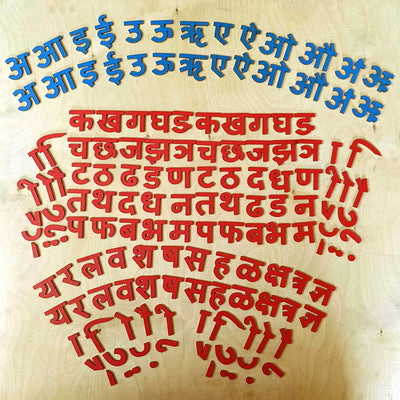
Montessori language activities begin with enriching vocabulary through real-life experiences and storytelling, moving to phonics with Sandpaper Letters, and then to reading and writing. Parents can encourage both English and regional languages, celebrating India's linguistic diversity. Providing a rich linguistic environment is vital, with parents modelling clear communication and encouraging conversations.
Mathematics
Concrete materials like the Red and Blue Rods, Golden Beads, and Stamp Game introduce mathematical concepts from quantity and symbol to operations, making abstract ideas tangible. Children naturally progress from understanding 'how many' to complex equations, building a strong, intuitive grasp of numbers. This approach helps children like 5-year-old Rohan grasp mathematical concepts with hands-on learning.
Culture
This broad area encompasses geography, history, botany, zoology, art, and music. Celebrating Indian festivals like Diwali, Holi, or Eid through stories, crafts, and food preparation becomes a natural part of the cultural curriculum. Research indicates that integrating cultural studies into education fosters a broader worldview and a stronger sense of identity in children.
Finding Best Homeschooling Curriculum India Resources
When selecting the best homeschooling curriculum India offers, look for resources that align with Montessori principles and are adaptable to your family's needs. While there isn't one 'official' Indian Montessori curriculum, numerous resources can guide you.
Online communities and local parent groups often share insights and materials. NCERT's Early Childhood Care and Education (ECCE) framework, while not explicitly Montessori, emphasizes play-based learning and developmentally appropriate practices, aligning well with the core principles of Montessori education. This framework provides a robust national context for understanding child development.
Investing in quality educational toys and activity kits that support hands-on learning is essential. Look for items made from natural materials, like wooden toys, which engage a child's senses and imagination without overstimulating. Children who play with 'boring' wooden toys often develop stronger problem-solving skills than kids with fancy electronic toys, because simpler toys make the child do the imagining, rather than being passively entertained.
Montessori at Home India: Practical Considerations
One of the unique insights of Montessori at home, especially in India, is recognizing that even daily routines and simple household items become 'materials' for self-directed learning, fostering a sense of 'my work' rather than 'my homework.' This directly addresses the pressure of academic burden often felt by children in traditional Indian schooling.
Consider the role of your family structure. While the Bombay High Court's ruling on joint parenting highlights the complexities of custody, for many families, homeschooling provides a consistent, stable environment. In a joint family setting, grandparents can become invaluable co-educators, sharing stories, traditions, and practical life skills. Encourage your child to participate in family discussions and decision-making where appropriate, fostering a sense of responsibility.
Regular observation of your child is the cornerstone of Montessori. Pay attention to what captures their interest, what they repeat, and what they struggle with. This allows you to tailor the environment and present new activities at the precise moment your child is ready, ensuring true self-paced learning. For instance, if you observe your 4-year-old repeatedly trying to tie their shoelaces, that's a signal to introduce a lacing activity or provide explicit instruction.
Your Next Step Towards Montessori Homeschooling
Embracing a Montessori homeschooling curriculum in India is a journey of discovery for both parent and child. It's about cultivating an environment where independence blossoms, curiosity is celebrated, and learning becomes an joyful exploration rather than a chore. Tonight, during dinner, ask your 3-year-old to describe the food using two words each, inviting them to engage their senses and language naturally.
SkilloToys.com is dedicated to supporting Indian parents on this path, offering a curated selection of Montessori method learning materials and educational toys that align with these principles. Remember, the goal is not to replicate a classroom, but to nurture a lifelong love for learning within the heart of your home.