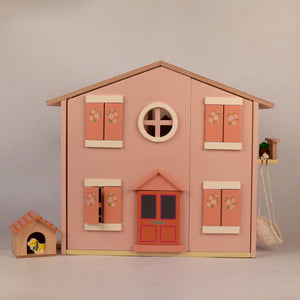
Choosing the Right Doll House for Kids (1-3 Years) in India
Choosing the right doll house for kids aged 1-3 years in India is a pivotal decision for fostering holistic development, as research indicates that well-selected open-ended toys significantly enhance cognitive and socio-emotional growth. For Indian parents navigating the vibrant yet sometimes overwhelming market, selecting a Montessori doll house means prioritizing designs that encourage independence, imaginative play, and a deep understanding of their immediate world. As India increasingly prioritizes early childhood development, highlighted by recent national summits on Women and Child Development, making intentional play choices like this aligns perfectly with nurturing our youngest generation.
A Montessori doll house is an open-ended, child-sized miniature environment designed to foster practical life skills, imaginative role-play, and socio-emotional development. This matters because it provides a safe space for toddlers to mimic real-world scenarios and understand their surroundings. Indian parents can observe their child's growing independence and social understanding through this focused play.
Why a Montessori Doll House is Essential for Toddlers (1-3 Years)
Child development experts agree that the 1-3 year age band is critical for building foundational skills. A thoughtfully chosen montessori doll house acts as a miniature world where toddlers can explore, experiment, and make sense of their daily lives. Unlike passive toys, a Montessori doll house demands active engagement, turning playtime into a powerful learning experience.
Fostering Practical Life Skills and Independence
In a Montessori setting, practical life activities are central to a child's growth. A doll house provides an opportunity for toddlers to replicate these activities in miniature. From arranging tiny furniture to tucking in dolls for a nap, these actions develop fine motor skills, hand-eye coordination, and a sense of order. For a 2-year-old like little Anya in Bengaluru, setting up her doll house for a family meal helps her process the dinner routines she observes daily, enhancing her sense of independence.
A Social Laboratory for Indian Families
The unique dynamics of Indian joint families, with grandparents, aunts, uncles, and cousins often under one roof, present rich social interactions. A doll house becomes a safe 'social laboratory' for toddlers to process these complex relationships. They can act out family gatherings, mimic conversations, or even practice empathy by comforting a doll. This role-play is a crucial part of developing emotional intelligence and understanding social norms, particularly relevant in our diverse cultural context.
Choosing Your Montessori Doll House: Age-Specific Guidance
Selecting the right doll house means understanding your child's developmental stage. What excites a 1-year-old will likely bore a 3-year-old, and what challenges a 3-year-old might frustrate a younger toddler. Always look for toys that invite curiosity without overwhelming.
For the 1-Year-Old: Simple Beginnings
For a child just crossing their first birthday, the best doll house for 1 year old will be robust, simple, and feature large, chunky pieces. Think a basic structure with wide openings and minimal, oversized furniture. At this stage, toddlers are primarily exploring cause and effect and developing gross motor skills. They might focus on putting objects in and out, or simply carrying the doll figures around. A small, accessible wooden playset can be an excellent starting point.
For the 2-Year-Old: Expanding Worlds
By age two, toddlers engage in more elaborate imaginative play. The best doll house for 2 year old should offer a bit more detail and slightly smaller, but still graspable, furniture. They start assigning roles to dolls and enacting short sequences, like a doll going to the 'kitchen' to 'cook' or having a 'bath'. This is when the doll house truly becomes an educational doll house for toddlers, allowing them to mimic daily routines they see at home or even festivals like miniature Diwali preparations.
For the 3-Year-Old: Complex Narratives
Three-year-olds are master storytellers. The best doll house for 3 year old can have more rooms, intricate details, and a wider range of accessories, perhaps including pets or garden elements. They will create complex narratives, often involving multiple characters and detailed storylines that reflect their growing understanding of the world. This advanced role-play hones language skills, sequential thinking, and creative problem-solving.
Materials Matter: Why Choose a Wooden Doll House in India
When considering an educational doll house for your toddler, the material is paramount. A wooden doll house India offers stands out for several reasons. Wood is durable, sustainable, and provides a sensory richness that plastic cannot replicate. The weight and texture of wood encourage deliberate, focused play, aligning perfectly with Montessori principles that value natural materials.
Research by the American Academy of Pediatrics (AAP) emphasizes the benefits of traditional toys made from natural materials for child development, noting their open-ended nature. Wooden toys are generally non-toxic, free from harmful chemicals often found in plastic, making them a safer choice for toddlers who explore with their mouths. A sturdy Montessori wooden toy collection, including a doll house, will last through years of play and can be passed down.
What to Look For: Key Features and Considerations
Open-Ended Design for Creative Freedom
A true Montessori doll house prioritizes open-endedness. This means fewer pre-defined elements and more room for your child's imagination. A simple, uncluttered structure encourages children to invent their own stories, furniture arrangements, and character roles, rather than being dictated by the toy's design. This fosters genuine creativity and problem-solving, which is far more valuable than a doll house with elaborate, fixed features.
Durability, Safety, and Accessibility
Toddlers are enthusiastic players, so durability is non-negotiable. Look for sturdy construction, smooth edges, and non-toxic finishes. Safety standards are paramount; ensure there are no small, detachable parts for children under three. Consider the size and accessibility: can your child easily reach all areas of the doll house? In Indian homes, where space might be a premium, a compact or foldable design can be a practical advantage.
Cultural Resonance in Play
While a Montessori doll house's core principles are universal, its play can be enriched by cultural resonance. Consider adding dolls that reflect Indian ethnicities, or miniature items that symbolize common household objects, festivals, or clothing from our culture. This helps your child see their world reflected in their play, making the experience more relatable and meaningful. For instance, tiny traditional utensils or miniature idols for a 'puja room' can spark unique Indian narratives.
Choosing a Montessori doll house for your toddler (1-3 years) is an investment in their holistic development. By focusing on natural materials, age-appropriate design, and open-ended play, you provide a powerful tool for learning and self-discovery. Explore our range of quality Montessori educational toys at SkilloToys.com to find the perfect doll house that will inspire years of imaginative play for your little one.