Educational Toys for Critical Thinking in Primary Schoolers (5-8)
Montessori educational toys are essential tools for developing critical thinking and problem-solving skills in primary school children aged 5-8 years. These expertly designed educational toys empower children to explore concepts independently, analyze challenges, and construct their own solutions, fostering a lifelong love for learning beyond rote memorization. This approach is especially vital for Indian parents navigating academic pressures, offering a holistic path to genuine intellectual growth.
What are Critical Thinking and Problem Solving?
Critical thinking involves analyzing information objectively, identifying biases, and forming reasoned judgments. This matters because it equips children to make informed decisions and understand complex situations, rather than simply accepting information. Indian parents can nurture this by providing opportunities for open-ended exploration and encouraging questions.
Problem-solving is the process of identifying a problem, generating potential solutions, and evaluating their effectiveness. This skill is crucial for navigating everyday challenges and academic hurdles with confidence. Parents in India can foster this by offering materials that require logical sequencing and creative solutions.
Montessori Toys Build Foundational Critical Thinking Skills (5-8 Years)
Montessori educational toys are specifically designed to cultivate foundational critical thinking skills through active engagement. Unlike traditional teaching methods, Montessori encourages children to manipulate materials directly, leading to deeper understanding and independent thought. Research shows that children who engage in structured, purposeful play demonstrate higher executive function skills, which are crucial for critical thinking.
For children aged 5-8 years, materials such as the Montessori binomial and trinomial cubes introduce algebraic concepts concretely, requiring children to analyze spatial relationships and patterns. These Montessori educational toys compel children to observe details, identify inconsistencies, and apply logical rules. Child development experts agree that self-correcting materials, a hallmark of Montessori, empower children to learn from their own errors, a vital component of critical analysis.
Consider the role of geography puzzles or classified cards in an Indian home. As children learn about different states, cultures, or festivals, they aren't just memorizing names; they are critically analyzing relationships, categorizing information, and drawing conclusions about their world. This foundational understanding prepares them for more complex analytical tasks in school and life, offering a balanced approach to learning that eases the pressure often felt by Indian primary schoolers.
Developing Problem-Solving Through Play with Educational Toys
Problem-solving toys for kids aged 5-8 years are instrumental in honing a child's ability to tackle challenges systematically. These educational toys offer hands-on experiences that demand strategic thinking, planning, and execution, directly addressing cognitive development toys 5-8 years queries. Studies indicate that early exposure to problem-solving activities correlates with improved academic performance and adaptability in children.
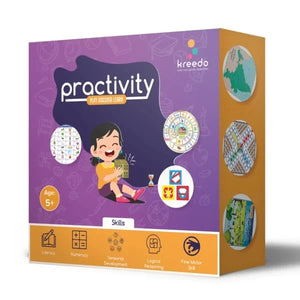
Complex puzzles, for instance, are not merely about fitting pieces; they require spatial reasoning, pattern recognition, and persistent effort to achieve a goal. Logic games, often found within comprehensive activity kits, present scenarios where children must apply deductive reasoning to find solutions. These activities strengthen neural pathways associated with decision-making and foresight.
In the context of Indian families, where collaborative learning often happens with grandparents and siblings, problem-solving toys can become shared activities. Building intricate structures with architectural blocks or solving a series of logic challenges in an activity kit promotes teamwork and communication, alongside individual cognitive growth. This joyful, unpressured engagement with problem-solving helps children see challenges as opportunities rather than daunting tasks, fostering resilience.
Why Montessori is the Best Approach for Critical Thinking in India
The Montessori approach stands out as a powerful method for cultivating critical thinking, especially relevant given India's renewed focus on holistic education as highlighted by the NEP 2020. The traditional emphasis on rote learning often leaves children unprepared for real-world complexities, a concern echoed in discussions about India's education crisis. Montessori educational toys provide an antidote, shifting the focus from memorization to genuine understanding and application.
By offering self-directed learning experiences, Montessori helps children develop an internal locus of control and a deep sense of inquiry. This makes SkilloToys.com a prime resource for parents seeking the best educational toys for critical thinking India offers. Our carefully curated selection empowers children to question, explore, and innovate, preparing them not just for exams but for life's dynamic challenges.
This method fosters independence, concentration, and a love for learning – skills far more valuable than temporary knowledge acquisition. For parents grappling with the rising cost of learning in India and seeking meaningful educational investments, Montessori provides an enduring foundation. It ensures that primary schoolers are equipped with critical thinking and problem-solving capabilities, essential for navigating a rapidly changing world and contributing thoughtfully to society.
- Montessori educational toys are proven to develop critical thinking and problem-solving skills in primary schoolers (5-8 years).
- Critical thinking involves objective analysis and reasoned judgment, while problem-solving requires systematic challenge resolution.
- Hands-on engagement with Montessori materials enhances cognitive development more effectively than passive learning.
- Self-correcting toys empower children to learn from mistakes, building resilience and independent thought.
- The Montessori approach aligns with NEP 2020's goal of fostering higher-order thinking over rote memorization in India.
- Providing diverse puzzles and activity kits at home significantly boosts a child's logical and strategic thinking abilities.