How Pretend Play Builds Mathematical Thinking in Children
Imagine your little one, engrossed in making a 'chai' for their favourite teddy bear, carefully pouring water from a small jug, or meticulously arranging play vegetables in a toy basket. It looks like simple fun, doesn't it? But did you know pretend play directly builds mathematical thinking in children, right there in your Indian home?
It's a powerful, often overlooked, connection that lies at the heart of how young minds grasp complex concepts. As parents exploring Montessori at home India, understanding this link can transform how you view playtime.
What is Pretend Play, Really?
Pretend play, often seen as simple child's fun, is actually a sophisticated form of learning where children mimic real-life situations and roles. This works because it allows them to process experiences, experiment with social interactions, and develop abstract thinking in a safe, self-directed environment. Parents can encourage this by providing open-ended materials and a supportive space for imaginative exploration.
The Hidden Math in Everyday Pretend Play
From a busy 'kirana' (grocery) shop to a bustling kitchen, children's imaginative worlds are rich with mathematical opportunities.
Counting and Quantity
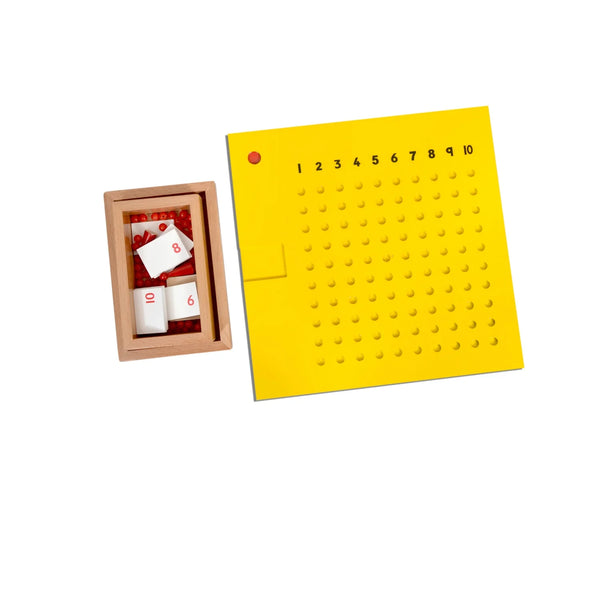
When your child plays 'dukan-dukan' (shop-shop) and counts out four imaginary 'ladoos' for their customer, they're engaging in one-to-one correspondence and quantity recognition. Or when they share play food among dolls, they're exploring division and equal distribution. These foundational experiences are crucial precursors to formal Montessori mathematics materials like the Number Rods.
Sorting and Classifying
Observe your child sorting coloured beads to make a 'necklace' for their pretend 'wedding,' or separating play fruits from vegetables. They are naturally developing classification skills, which are fundamental to understanding sets and data in mathematics. This simple act of categorising lays the groundwork for logical reasoning.
Patterns and Sequencing
Arranging building blocks by size to construct a 'ghar' (house), or creating a repetitive sequence with small pebbles, are excellent examples of patterning. When they narrate a story, following a beginning, middle, and end, they are internalising sequencing – a core mathematical concept for understanding operations and problem-solving. Think of the beautiful 'rangoli' patterns our grandparents make; these are real-life math lessons!
Measurement and Estimation
In a play kitchen, when a child decides they need 'more' flour for their imaginary 'roti' or tries to fit a 'lid' onto a pot, they are experimenting with measurement and spatial reasoning. They estimate quantities and compare sizes, building an intuitive understanding of concepts like bigger/smaller, heavier/lighter, and capacity.
Problem-Solving and Logic
Pretend play is a constant stream of miniature challenges: 'How do I make sure everyone gets a piece of cake?' 'Where will the little puppy sleep?' Each scenario encourages logical thought, planning, and creative solutions – all critical aspects of mathematical thinking.
Montessori at Home: Nurturing Pretend Play for Math Skills
Montessori education champions self-directed learning and a prepared environment, which perfectly complements math-rich pretend play. Providing children with open-ended educational toys for toddlers and a space for free exploration allows their mathematical thinking to flourish organically.
In your Indian home, this could mean setting up a small 'kitchen' with actual miniature utensils and old spice boxes, allowing children to 'cook' alongside you. Or using traditional 'diya' (lamps) for counting and arranging. Grandparents often naturally encourage this through storytelling and playful interactions, enriching a child's imagination and mathematical exposure.
From Mundane to Magical: Simple Ways to Encourage Math-Rich Pretend Play
Encouraging this type of play doesn't require elaborate setups. Focus on providing materials and opportunities:
- A Play Kitchen Corner: Use old vessels, plastic fruits/vegetables, or even empty food cartons. Children will count ingredients, measure imaginary portions, and sort items.
- The 'Shop' Experience: Create a small 'dukan' with items from around the house – bangles, small boxes, leaves as 'money.' This fosters counting, basic transactions, and role-playing.
- Building Zones: Offer blocks, LEGOs, or even natural materials like pebbles and twigs. This develops spatial awareness, geometry, and problem-solving as they construct.
- Storytelling Props: Use puppets, dolls, or even figures made from clay or old clothes to act out stories. This reinforces sequencing and logical progression.
Remember, the goal is to let your child lead. Their imagination is the most powerful tool for learning. By providing simple, engaging Montessori learning activities and a nurturing environment, you're not just fostering creativity; you're building a strong foundation for mathematical thinking.