Play-Based Learning: Early Child Development in India
Play-based learning robustly fuels holistic early childhood development in India by naturally integrating cognitive, social-emotional, physical, language, and creative growth through engaging activities. It provides a developmentally appropriate foundation, crucial for children aged 0-6 years, fostering curiosity and resilience over rote memorisation. This approach aligns with current Indian educational discourse emphasizing a joyful, comprehensive start for every child.
As India looks towards a 'Viksit Bharat,' the emphasis on nurturing our youngest minds through effective early childhood education has never been stronger. Recent reports from UNICEF and BW Education highlight the critical importance of these foundational years. This guide explores how play-based learning is the cornerstone for building well-rounded, capable individuals, ready for life's challenges.
What is Play-Based Learning?
Play-based learning is an educational approach where children explore, discover, create, and interact with the world through play. This matters because it allows children to construct knowledge actively and develop critical skills naturally, unlike traditional rote methods. Indian parents can integrate this by providing open-ended materials and valuing their child's self-directed exploration.
Early Childhood Education India: The Foundation of Future Success
The conversation around early childhood education in India is evolving, moving beyond mere academics to encompass holistic growth. Research indicates that investments in quality early learning yield a 7-10% return on investment annually in terms of increased adult earnings and societal benefits. This shift, championed by organizations like UNICEF and discussed in articles such as BW Education's 'The Brain Before Books,' acknowledges that the early years are paramount for brain development, impacting lifelong learning and well-being. Play-based learning directly supports this national imperative by engaging children in meaningful ways.
Cognitive Growth: Building Brilliant Minds Through Play
Play is a child's natural laboratory for cognitive development. Through activities like problem-solving with puzzles, building towers, or exploring cause-and-effect, children develop critical thinking skills, memory, and spatial awareness. For instance, engaging with Montessori materials like the Pink Tower helps children grasp concepts of size and sequence through hands-on manipulation, far more effectively than abstract instruction.
Studies consistently demonstrate that children engaged in play-based learning exhibit higher problem-solving skills and better academic readiness by age seven. They learn to hypothesise, test, and adapt, essential cognitive functions that prepare them not just for school, but for navigating a complex world. This approach contrasts sharply with the pressure of early rote memorisation often seen in Indian educational settings, providing a joyful path to deep understanding.
Social-Emotional Skills: Nurturing Empathetic Hearts
In our bustling Indian homes, often with joint families and community celebrations, social-emotional learning through play is naturally interwoven into daily life. Children learn to share toys, negotiate roles during pretend play like 'ghar-ghar,' and understand different perspectives. These interactions foster empathy, cooperation, and conflict resolution—skills vital for healthy relationships throughout life.
Child development experts agree that unstructured play, especially with peers and family, is crucial for developing emotional intelligence. It allows children to express feelings, manage frustration, and build self-confidence in a safe, low-stakes environment. This is particularly valuable in India, where collective well-being and strong family bonds are highly cherished values.
Physical Development: Active Bodies, Agile Minds
From chasing a ball in the garden to carefully threading beads, play-based learning naturally integrates physical development. Gross motor skills like running, jumping, and climbing build strength and coordination, while fine motor skills are honed through activities such as drawing, manipulating small objects, or engaging with activity kits that involve intricate hand movements.
These physical activities are not just about exercise; they are deeply connected to cognitive development. For instance, fine motor control is foundational for writing readiness, and spatial awareness developed through movement impacts mathematical understanding. Encouraging children to explore their physical capabilities through joyful play builds confidence and a healthy relationship with their bodies.
Language & Communication: The Power of Expression
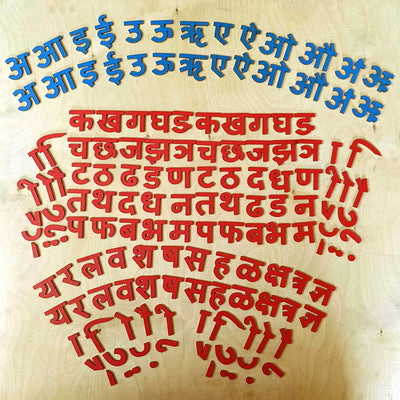
Play provides a rich context for language acquisition and communication skills. Whether it's narrating a story with puppets, engaging in dramatic play, or asking questions about a new toy, children are constantly expanding their vocabulary and learning sentence structures. Montessori materials like sandpaper letters also provide a tactile foundation for understanding letter sounds and shapes, bridging sensory experience with literacy.
In a multilingual country like India, play is an invaluable tool for children to navigate and integrate different languages, often effortlessly. Conversations with grandparents, storytelling during festivals, and imaginative scenarios all contribute to a child's robust linguistic development, fostering their ability to express thoughts and understand others effectively.
Creative & Imaginative Play: Fueling India's Innovators
The power of imagination in early childhood is limitless. Through creative and imaginative play, children develop innovative thinking, problem-solving abilities, and the capacity for abstract thought. Building fantastical worlds with blocks, dressing up as community helpers, or creating stories about a favourite festival allows children to explore possibilities without boundaries.
This type of play is crucial for fostering adaptability and resilience, qualities highly valued in India's rapidly evolving landscape. It encourages children to think outside the box, to experiment, and to find unique solutions—skills that are foundational for future innovation and leadership.
Play Learning for Preschoolers: Specific Applications
For preschoolers (ages 3-6), play-based learning becomes more structured yet remains child-led. Activities like dramatic play areas mimicking a doctor's clinic or a grocery store, block building for engineering concepts, or art projects encouraging self-expression are highly effective. These experiences allow children to practice social roles, develop logical reasoning, and refine fine motor skills in preparation for formal schooling. It's about learning through doing, not just observing.
Child Development Stages Play: Adapting to Age
Effective play-based learning is always age-appropriate. For infants (0-12 months), sensory play like tummy time with textures or listening to rhymes is key. Toddlers (1-3 years) benefit from exploratory play, like stacking blocks or simple sorting. Preschoolers (3-6 years) engage in more complex imaginative play, rule-based games, and collaborative projects. Understanding these stages allows parents and educators to provide the right kind of stimuli for optimal development, ensuring that play is always meaningful and engaging.
Holistic Development Early Years: A Comprehensive Approach
Ultimately, play-based learning champions holistic development in the early years by seamlessly integrating all developmental pillars. It views the child as a complete individual, where cognitive growth isn't separate from emotional well-being, and physical activity enhances language acquisition. SkilloToys offers a wide range of Montessori method learning materials designed to support this comprehensive approach, ensuring that every child has access to tools that nurture their potential.
This integrated approach is particularly vital in India, where the pressure for early academic achievement can sometimes overshadow the broader developmental needs of a child. Play-based learning ensures that children develop a robust foundation across all areas, fostering joyful learners who are curious, confident, and well-equipped to thrive.
Embracing play-based learning is not just an educational choice; it's a commitment to nurturing the full potential of every child in India. It empowers them to explore, discover, and grow in a way that is natural, joyful, and profoundly effective, aligning perfectly with the vision of a brighter future for all.
- Play-based learning is foundational for holistic early childhood development in India, covering cognitive, social-emotional, physical, language, and creative domains.
- It actively addresses India's current emphasis on Early Childhood Education, as advocated by UNICEF and BW Education.
- Children who engage in play-based learning exhibit superior problem-solving abilities and enhanced academic readiness.
- Montessori principles, like self-directed exploration with materials such as sandpaper letters and the pink tower, are core to effective play-based learning.
- Integrating play-based learning mitigates the pressure of early academics, fostering joyful and deeper learning experiences.
- Quality play environments at home and in schools are critical investments for a child's future, yielding significant long-term societal returns.
What age is best for play-based learning in India?
Play-based learning is crucial for children across all early childhood stages, ideally from birth through age six. It adapts to different developmental needs, from sensory exploration for infants to imaginative role-playing for preschoolers, making it universally beneficial.
How does play-based learning prepare children for school in India?
Play-based learning prepares children for formal schooling by developing essential foundational skills like problem-solving, critical thinking, and social collaboration. It builds a love for learning and curiosity, crucial for navigating academic challenges beyond rote memorisation, as highlighted by initiatives like 'The Brain Before Books.'
Can play-based learning coexist with academic pressure in Indian homes?
Absolutely. Play-based learning offers a joyful counter-balance to academic pressure, ensuring children develop comprehensively without burnout. It proves that deep learning and skill acquisition occur naturally through engagement, ultimately enhancing academic performance and reducing stress for both children and parents.
What are simple ways Indian parents can encourage play-based learning at home?
Indian parents can encourage play-based learning by providing open-ended materials like blocks, art supplies, or even kitchen utensils for safe exploration. Engage in storytelling, encourage pretend play about daily life or festivals, and allow children unstructured time to follow their own curiosity. Remember, less structured play often leads to richer learning.
Does play-based learning help children develop social skills in a joint family setting?
Yes, play-based learning thrives in a joint family setting, offering rich opportunities for social development. Children learn sharing, cooperation, negotiation, and empathy by interacting with siblings, cousins, and grandparents during communal play. This natural interaction fosters strong social bonds and essential interpersonal skills.